Bad ECM Symptoms in 2026: Signs of a Failing ECM
Bad ECM symptoms usually show up as a check engine light that keeps returning, random stalling, a crank with no start, poor fuel economy, lost power, or rough shifting. The engine control module (ECM) is your engine’s computer, so when it struggles the trouble can spread across several systems at once instead of pointing at one part.
The hard part is that these same signs can come from a cheap sensor, a weak battery, or a corroded ground. This guide covers the real signs of a failing ECM, what tends to imitate them, and how to confirm the module before you replace it. The terms ECM, ECU, and PCM often name the same computer, and some people just call it the car’s computer.
Key Takeaways
- A bad ECM can cause several symptoms at once. The clearest sign is several engine problems appearing together, such as stalling, a returning check engine light, and hard starting.
- ECM, ECU, and PCM usually name the same computer. Symptoms of a bad ECU or a bad PCM overlap almost entirely with bad ECM symptoms.
- Many “bad ECM” symptoms trace to something cheaper first. A failing sensor, low battery voltage, a blown fuse, or a corroded ground can copy a dead module.
- No communication with a scan tool is one of the strongest ECM warnings. When power and ground are good and the module still will not respond, replacement moves up the list.
- Confirm before you replace. A scan for trouble codes plus a check of power, grounds, and fuses separates a bad module from a bad connection.
What Are the Symptoms of a Bad ECM?
A bad ECM can cause symptoms across fuel, spark, idle, and emissions, because the module manages all of them. An engine control unit controls the fuel injection and ignition systems, so a fault can touch how the engine starts, idles, accelerates, and shifts.
| Symptom | What you may notice | Why the ECM is a suspect |
|---|---|---|
| Returning check engine light | Codes come back after repairs | The same control problem may still be present |
| Random stalling or rough idle | Engine shakes or shuts off at idle | Module may lose steady control of fuel, spark, or idle |
| Crank with no start | Starter turns, engine will not run | Injector, spark, or security commands may be missing |
| Misfires | Engine stumbles or runs rough under load | Fuel or spark timing may be wrong |
| Poor fuel economy | Miles per gallon drop with no other change | Air-fuel mixture may be miscalculated |
| Loss of power | Sluggish or hesitant acceleration | Throttle and sensor readings may be misread |
| Harsh or delayed shifting | Gear changes feel hard or late | Engine data shared with the transmission may be wrong |
| No scan communication | Scanner cannot talk to the module | Power, ground, wiring, or the module may be at fault |
| Codes across unrelated systems | Several faults appear at once | Module power or an internal fault may affect many circuits |
One symptom on its own usually points to one part. Several of these appearing together point back toward the module.
Engine Signs of a Failing ECM
A Check Engine Light That Keeps Coming Back
A check engine light that returns after repairs can be a sign of a bad ECM. The light is part of the on-board diagnostic (OBD-II) system, which uses diagnostic trouble codes to identify malfunctions in the vehicle. A stored code is a clue, not a verdict. It names the circuit with a problem, not the exact part that failed, so a code that keeps returning after the named sensor is replaced can point back at the module or its wiring. Our guide to reading car computer codes explains how to read what a code is really telling you.
A trouble code points at a circuit, not a failed part, so a code that keeps returning can point back at the ECM or its wiring.
Stalling, Rough Idle, and Misfires
Random stalling, a rough idle, and misfires can all follow a failing ECM, because the module sets the fuel, spark, and idle commands the engine needs every second it runs. The engine control module regulates the fuel injectors, ignition timing, and air intake, so unsteady commands show up as an engine that surges, shakes, or shuts off. The pattern matters most when stalling returns after common causes, like a dirty idle valve or a weak ignition coil, have already been checked.
Cranks but Will Not Start
A crank with no start happens when the starter turns the engine but it never catches. A failing ECM can cause this by not firing the fuel injectors, not reading the crankshaft signal, or not clearing the security system. Because the engine computer controls the fuel injection and ignition systems, a module that stops sending those commands leaves the engine with air but no ignition or injection event. A blown fuse or a dead battery can copy this exactly, so a no-start is worth confirming before you condemn the module.
Poor Fuel Economy and Lost Power
Poor fuel economy and sluggish acceleration can be bad ECM symptoms, because the module sets the air-fuel mixture from live sensor data. The ECM reads sensors such as the oxygen sensor, mass airflow sensor, and throttle position sensor, and a bad reading or a bad calculation can make the engine run rich, run lean, or respond slowly. A sudden drop in miles per gallon, or a car that hesitates when you press the pedal, can trace to the module or to one of those sensors feeding it. When the engine pulls back power on its own, see our guide on what to do when a car is stuck in limp mode.
Harsh or Delayed Shifting
Harsh or delayed shifting can be a bad ECM symptom on many vehicles, because the engine computer shares data with the transmission. On some vehicles a separate transmission control module (TCM) runs the gears, while on others a combined powertrain control module (PCM) runs the engine and transmission together. When the engine data is wrong, shift timing can suffer. Our explainer on the difference between an ECM, TCM, and PCM covers which module does what.
Which module runs the gears depends on the vehicle, which is why a bad ECM can cause harsh or delayed shifting on some vehicles.
The Electrical Warning Signs
No Communication With the Scan Tool
No communication with a scan tool is one of the strongest signs of a bad ECM. If a working scanner cannot connect, the cause is either the module or the power, ground, fuse, or network wiring that feeds it. When power and ground both check out and the module still will not respond, a failed ECM becomes a reasonable conclusion. Our guide on a scan tool with no communication walks through how to narrow it down.
Fault Codes Across Unrelated Systems
Trouble codes across several unrelated systems can point at the module rather than any one sensor. A single sensor fault usually sets one related code. A spread of unrelated codes can mean the module’s power, ground, or internal board is the shared problem. One code points directly at the computer: P0606 is a control-module processor fault, a code the module sets when it fails its own internal self-check.
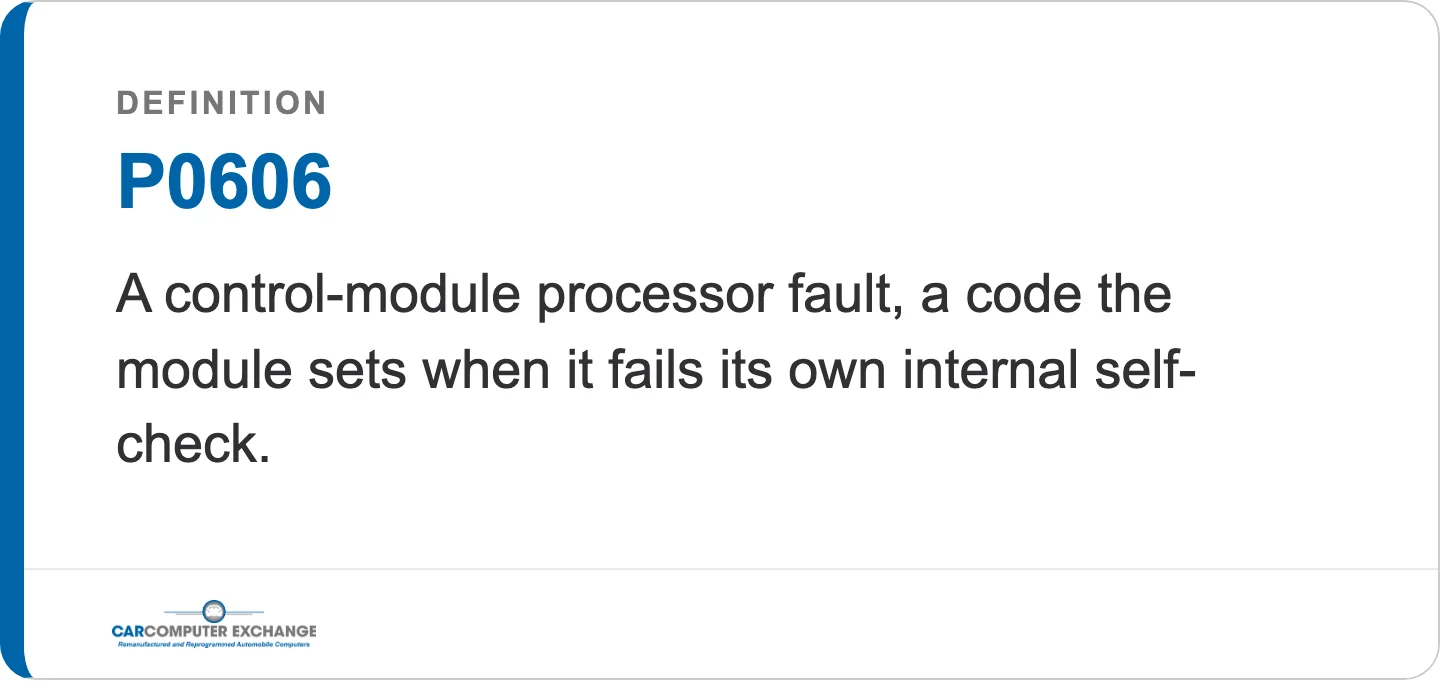
P0606 is a trouble code that points directly at the engine computer itself. Source: CarParts.com.
Symptoms That Come and Go With Heat or Vibration
Bad ECM symptoms that appear only when the engine is hot, or only when the vehicle is moving, can point to a module fault. Heat, vibration, and moisture can work solder joints loose, corrode a circuit board, or open a weak connection over time. The same pattern can also come from a sensor or a wiring connection, and these faults are hard to catch because they can clear before a shop sees them.
What Else Can Look Like a Bad ECM
Many symptoms blamed on a bad ECM trace to something cheaper and easier to fix. The module needs clean power and a solid ground to work, so a fault in that supply can copy a dead computer. Check these before replacing the module:
- Low battery or charging voltage. A weak battery or a failing alternator can confuse the electronics and set module codes that clear once voltage is restored. A check engine light that appears right after a dead battery is a common example.
- Corroded or loose grounds. The ECM relies on clean ground connections. A ground that looks fine can fail under load and cause stalling, no-starts, or loss of communication.
- A blown fuse or bad relay. A single blown fuse in the module’s power feed can cause a no-start that looks like module death but costs a few dollars to fix.
- A failing sensor or shorted wire. A shorted sensor circuit can pull a signal line down and make the module look dead. A code for low signal input often means a wire is open or shorted, not that the ECM has failed.
Test the wiring and the basics before you condemn the module.
How to Confirm It’s the ECM Before You Replace It
Confirm a bad ECM with a scan and a few basic checks before buying a module. The goal is to rule out cheaper causes, such as a weak battery, a bad ground, or a blown fuse, then decide with evidence instead of a guess.
- Scan for trouble codes. Read the codes with an OBD-II scanner. Many auto parts stores read codes for free, which is a quick first step, and some will test a battery and alternator too. Note whether the codes point at one circuit or several.
- Check power and grounds. Confirm the module has battery voltage on its power pins and clean grounds. Repair a bad ground before anything else.
- Check the fuses and relays that feed the module, since a single blown fuse can copy a dead computer.
- Watch for the pattern. One isolated code with a clear cause is probably that part. Several unrelated codes, or no communication once power and grounds check out, point back at the module.
If the codes and the checks all point back to the module rather than a sensor or a connection, the ECM is the likely cause.
If the ECM Really Has Failed
If a scan and the basic power, ground, and fuse checks point to a failed ECM, the next step is a replacement module programmed to your vehicle. Car Computer Exchange offers replacement ECMs, PCMs, and TCMs. Warranty and core-return terms are on our warranty page. On a standard replacement, a core return means sending your old module back to us after you install the new one. Check the listing for any relearn or setup steps your vehicle needs.
To match the right module, have your VIN and your vehicle’s year, make, model, engine size, and transmission ready. A photo of the old module’s part-number label helps confirm the exact fit. Enter your year, make, and model on our homepage, or browse by make, such as Ford or Dodge. If you are weighing a repair against a replacement, our guide on when it’s time to replace an ECM walks through the decision.
Frequently Asked Questions
Can bad ECM symptoms come and go?
Yes. Heat, vibration, weak connections, and internal faults can make bad ECM symptoms appear and disappear. An intermittent problem does not mean the module is fine. It often means a connection or a solder joint is failing under certain conditions.
Will a bad ECM always turn on the check engine light?
No. Some ECM problems cause stalling, a no-start, or no scan communication without a clear warning light. A failing module can also fail to run the light itself, so a dark dashboard does not rule the ECM out.
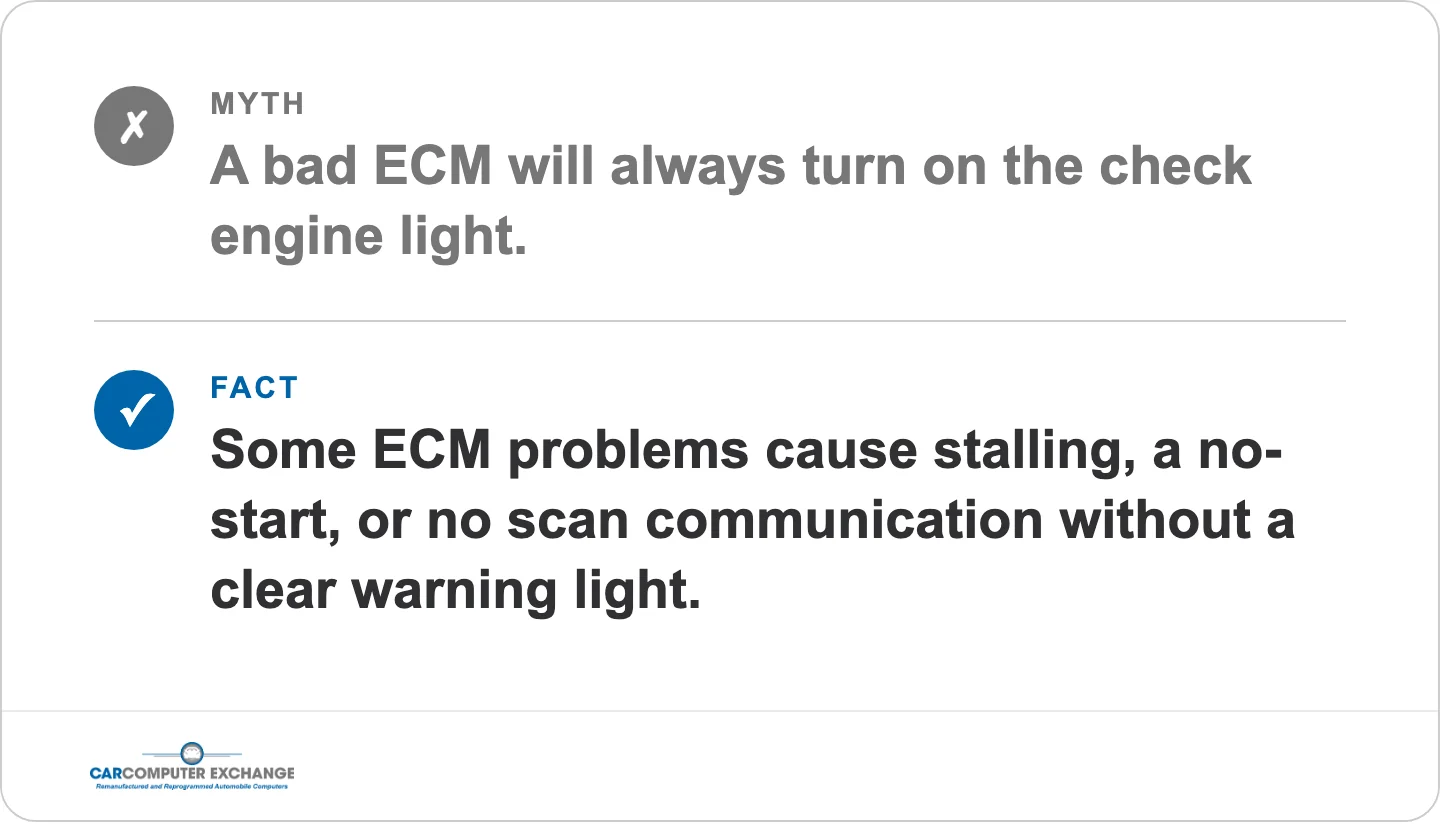
A dark dashboard does not rule the ECM out, because a failing module can also fail to run the light itself.
Can a bad ECM cause a no-start?
Yes. If the module does not send the fuel, spark, or security commands the engine needs, it can crank without starting. Because a blown fuse or a dead battery can cause the same thing, confirm power and ground before replacing the module.
Can a bad ECM cause transmission problems?
Yes. On vehicles where the engine computer shares data with the transmission, or where one powertrain control module runs both, a fault can cause harsh or delayed shifting. A separate transmission control module handles shifting on some vehicles, so the cause is worth confirming first.
How can I tell if it’s the ECM and not a sensor?
Compare the codes and the pattern. A single sensor code with a clear cause usually is that sensor. Several unrelated codes or no communication with a scan tool point more toward the module. Checking power, grounds, and fuses separates the two.
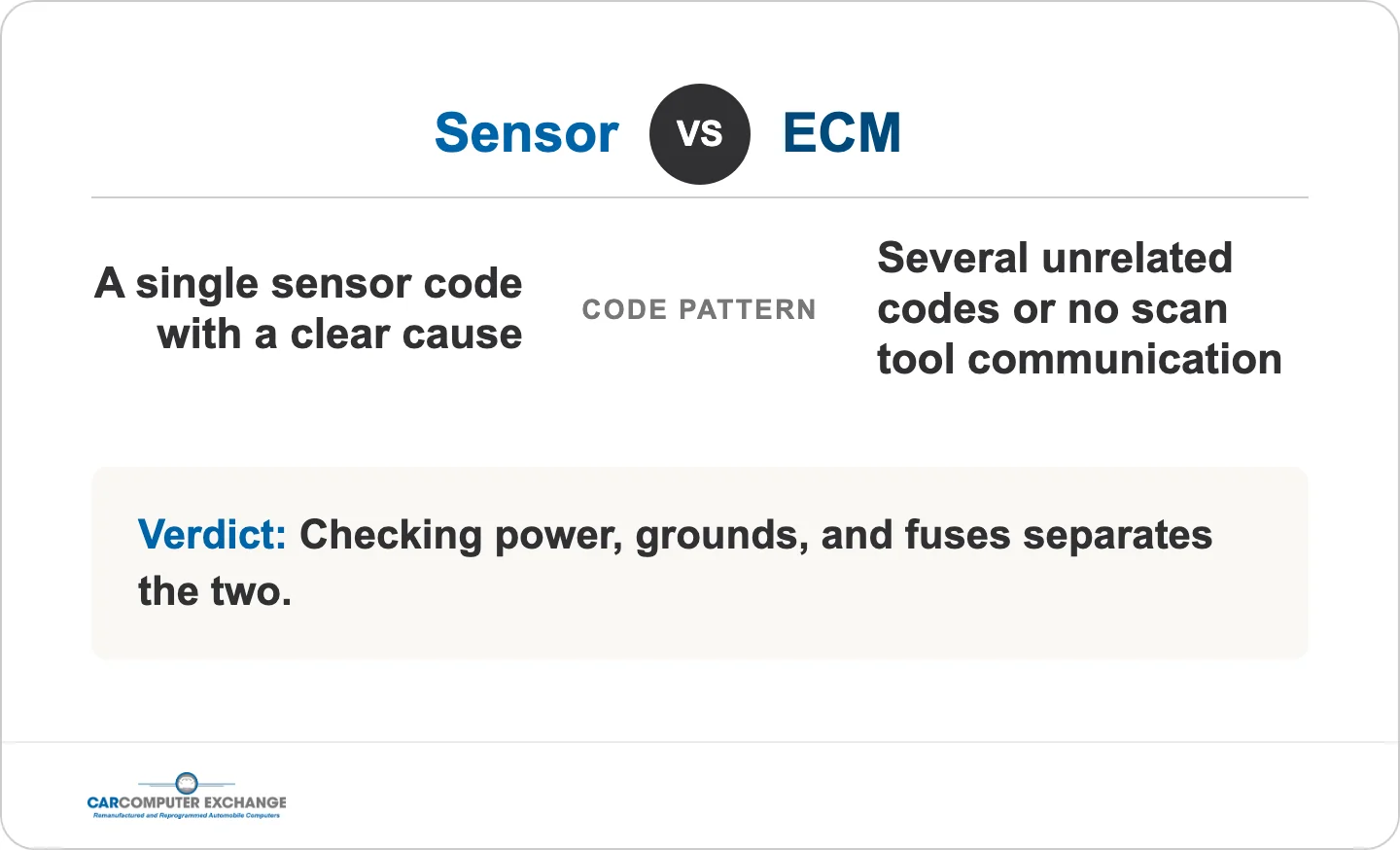
The code pattern is what separates a bad sensor from a bad ECM, and checking power, grounds, and fuses confirms it.
Can I drive with a bad ECM?
Driving with a bad ECM can be risky. If the vehicle stalls, loses power, or drops into limp mode, it may be unsafe in traffic. It is better to diagnose the problem than to keep driving on it.
Conclusion
Bad ECM symptoms are easiest to spot as a group. A check engine light that keeps returning, stalling, a no-start, poor fuel economy, lost power, or rough shifting showing up together is the pattern that makes the engine computer a real suspect. Because the same signs of a bad ECU or PCM can come from a sensor, a battery, a fuse, or a ground, the smart move is to scan for codes and check the basics before you replace anything.
When the evidence does point at the module, the next step is a replacement programmed to your vehicle. Car Computer Exchange offers replacement ECMs, PCMs, and TCMs, with warranty terms on our warranty page. Start by entering your year, make, and model to find the module that matches your vehicle.
Sources