ECM Reflashing: What It Is and How It Works in 2026
ECM reflashing is the process of updating or rewriting the software stored on a vehicle’s engine control module (ECM). It uses a J2534 pass-through device and OEM-specific software to overwrite the ECM’s existing calibration with a newer or modified version. Reflashing can fix drivability problems, restore factory settings after a component replacement, or bring an ECM up to date with the latest manufacturer software.
Key Takeaways
- ECM reflashing rewrites your engine computer’s software without replacing the physical module. It requires a J2534 pass-through device, OEM software, and a stable power source.
- A basic reflash at an independent shop costs $150 to $300. Dealer reprogramming runs $200 to $600, and full ECM replacement with programming can reach $1,000 to $2,500.
- DIY reflashing is possible but requires specific equipment including a Windows PC, J2534 device, OEM software subscription, and a battery charger to prevent bricking.
- If your ECM hardware is damaged, reflashing will not fix it. A VIN-programmed replacement module is the faster and often cheaper path compared to dealer diagnosis plus reflashing fees.
What Is ECM Reflashing?
ECM reflashing (also called ECM reprogramming or ECU reflashing) is the process of downloading a new calibration file to the engine control module through the vehicle’s OBD-II diagnostic port or a direct bench connection. The calibration file contains the instructions the ECM uses to manage fuel injection timing, ignition timing, idle speed, emissions controls, and transmission shift points.
Three types of vehicle computers handle these functions. The ECM (engine control module) manages the engine. The PCM (powertrain control module) manages both engine and transmission in a single unit. The TCM (transmission control module) handles transmission functions independently. When someone says “ECM reflash,” they typically mean updating the software on whichever module controls their vehicle’s powertrain.
Reflashing differs from ECM replacement. Reflashing keeps the same physical hardware and updates only the software. Replacement swaps the entire module for a remanufactured or new unit that arrives pre-programmed. Both achieve updated software, but reflashing only works when the ECM hardware is functioning correctly.
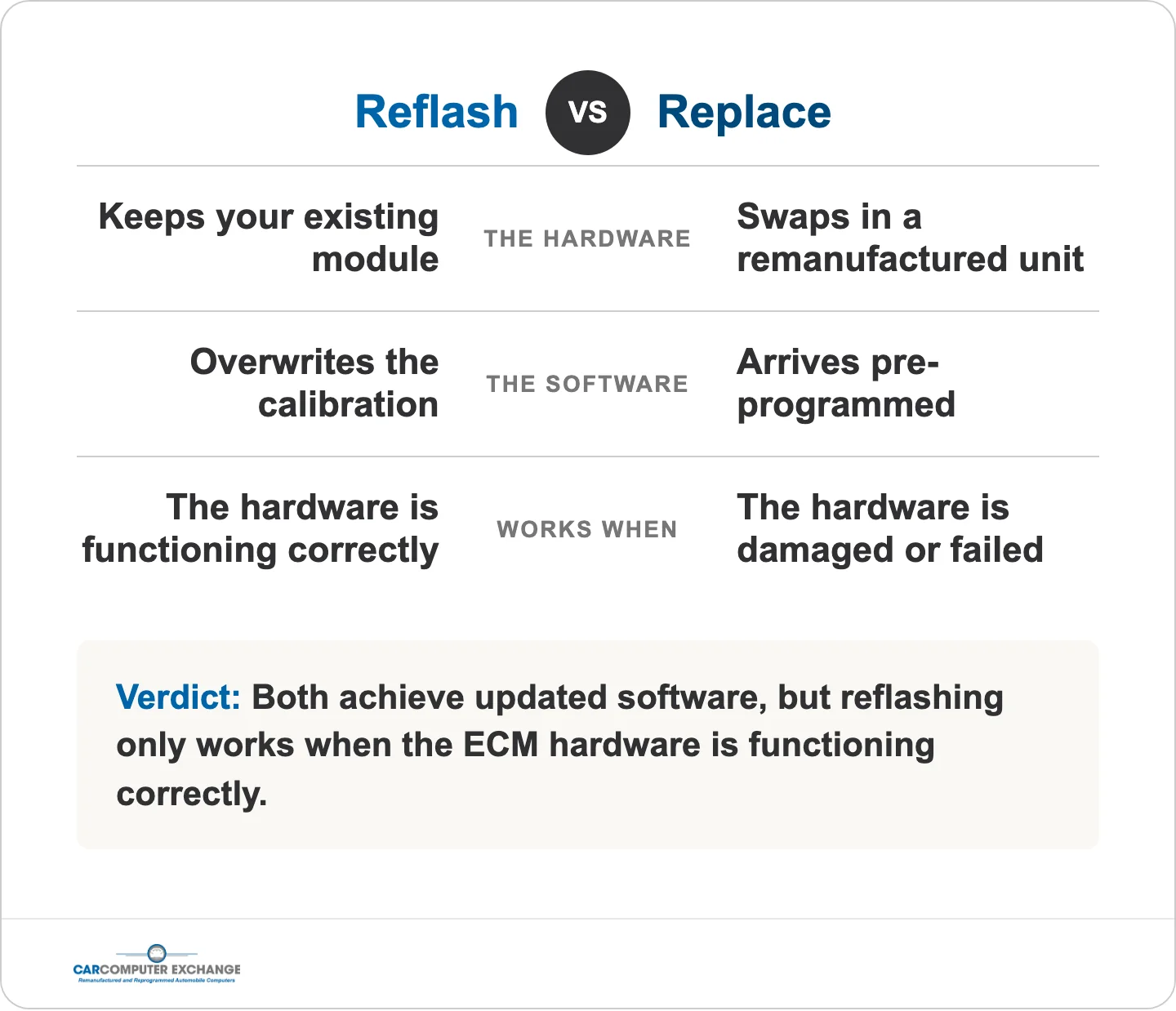
Both end with updated software. Only one of them fixes broken hardware.
When You Need an ECM Reflash
An ECM reflash is needed when the module’s software is outdated, corrupted, or mismatched to the vehicle’s current configuration. These are the most common triggers:
- Persistent check engine light with software-related DTCs. Some diagnostic trouble codes point to calibration errors rather than sensor or component failures. A reflash loads the corrected calibration. Always test the ECM and rule out sensor issues before assuming the ECM needs reflashing.
- After major component replacement. Installing new fuel injectors, a turbocharger, an EGR valve, or replacing the ECM itself can require a reflash so the module’s software matches the new hardware configuration.
- Manufacturer TSB or recall update. Automakers release technical service bulletins with updated calibration files that fix known issues like rough idle, harsh shifting, or poor fuel economy. Dealers apply these through reflashing.
- Emissions compliance recalibration. Vehicles that fail emissions testing due to software-related issues (not hardware faults) may need a reflash to bring the ECM’s emissions parameters back to the current standard. According to Bosch Diagnostics, the EPA mandated J2534 access for emissions-related ECU reprogramming starting with model year 2004.
- Immobilizer or security key sync. After an ECM replacement, the security system may need to be reprogrammed so the new module recognizes the vehicle’s existing keys. Some vehicles require a dealer scan tool for this step.
- Performance or drivability issues after battery disconnect. Disconnecting the battery resets the ECM’s adaptive learning values. While most vehicles relearn on their own, some require a reflash to restore proper operation.
Essential Tools and Equipment for ECM Reflashing
ECM reflashing requires specific hardware and software. According to DG Technologies, the SAE J2534 standard is mandated by the EPA for all emissions-related ECU reprogramming from model year 2004 forward.
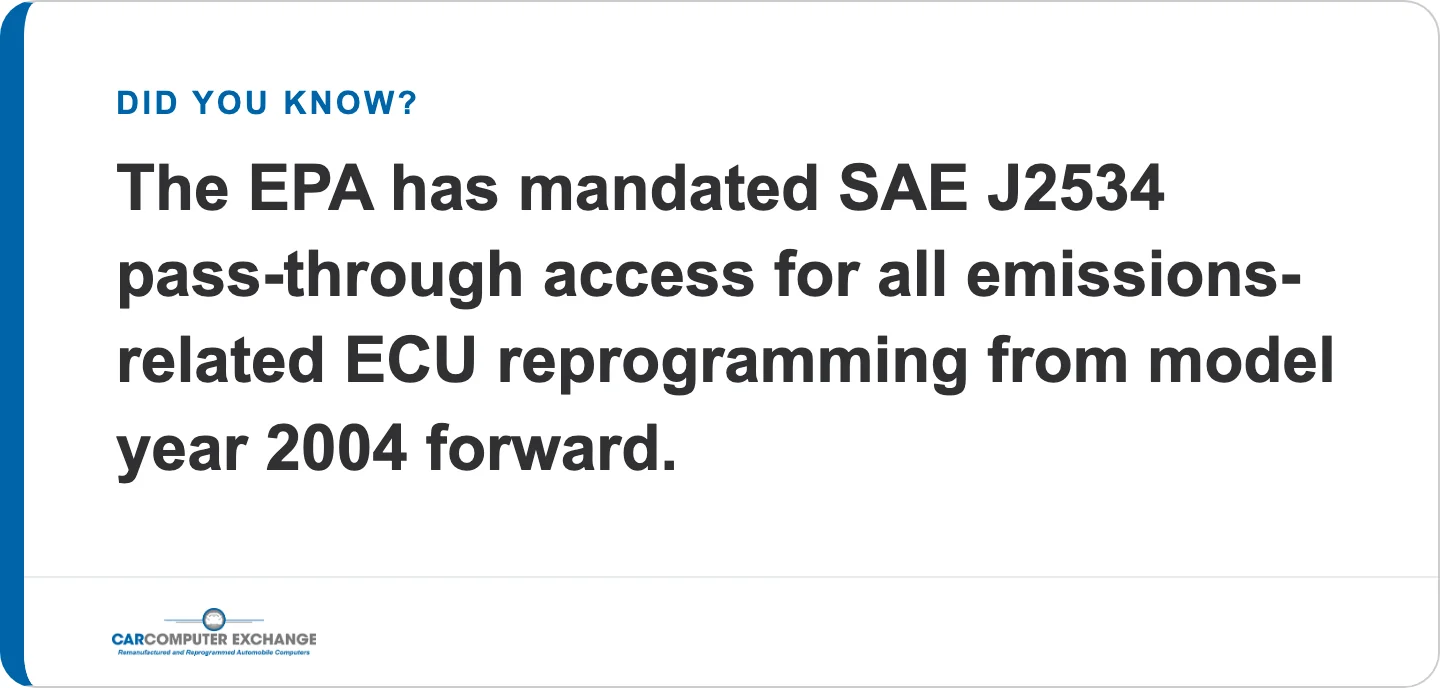
Why any shop, not just a dealer, can legally reflash an emissions-related module.
- Hardware: J2534 pass-through device. This is the physical interface between your laptop and the vehicle’s OBD-II port. Common devices include models from Autel, Bosch, and Drew Technologies. The device translates software commands into the communication protocols the ECM understands.
- Software: OEM-specific programming platform. Each manufacturer requires its own software to access calibration files. GM uses TIS2Web/SPS (Service Programming System). Ford uses IDS (Integrated Diagnostic System) or FDRS. Chrysler/Stellantis uses wiTECH 2.0. Cummins uses INSITE. Toyota uses Techstream. Each platform requires a paid subscription or per-session access fee.
- Stable power source: battery charger or maintainer. Voltage must stay above 12V throughout the entire flash process. If battery voltage drops during a reflash, the ECM can be bricked, rendering it permanently non-functional. A battery charger connected during the process is a requirement, not a precaution.
- Laptop: Windows PC with internet connection. OEM software platforms run on Windows. An active internet connection is needed to download the correct calibration file from the manufacturer’s server. A wired ethernet connection is more reliable than Wi-Fi for large file transfers during the flash.
How to Reflash an ECM: Step-by-Step Process
This 6-step process covers how ECM reflashing works, whether performed at a shop or as a DIY procedure. Each step requires careful attention to prevent bricking the module.
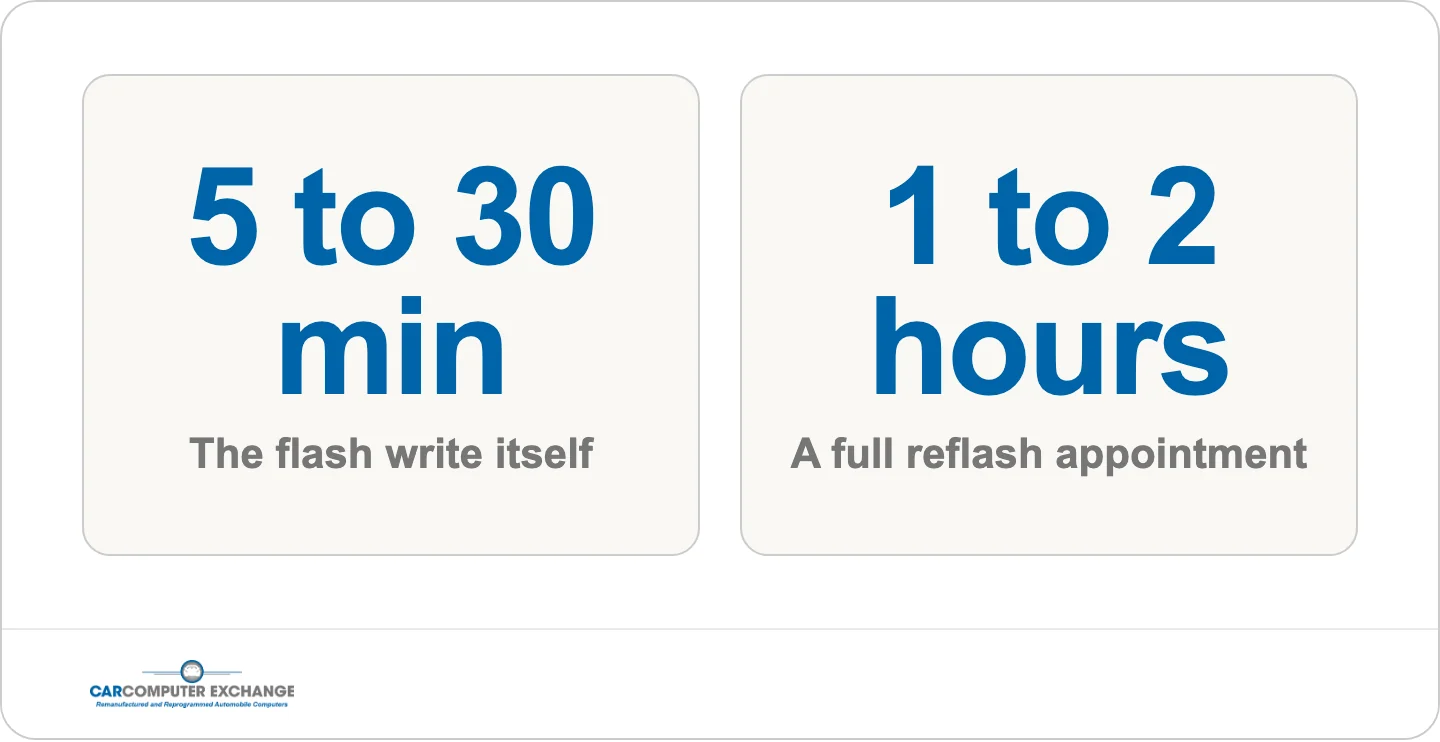
The write itself is quick. The appointment around it is not.
- Connect the J2534 device to the vehicle’s OBD-II port. Plug the pass-through device into the 16-pin OBD-II diagnostic connector, typically located under the dashboard on the driver’s side. Connect the other end to your laptop via USB. For bench flashing (ECM removed from the vehicle), use a bench harness that provides power and communication directly to the module.
- Turn the key to On, Engine Off (KOEO). The ignition must be in the “on” position but the engine must not be running. This powers the ECM and enables communication without engaging engine systems. Verify the battery charger is connected and holding voltage above 12.6V before proceeding.
- Select the correct calibration file for the vehicle’s VIN. Open the OEM software platform and enter the vehicle’s VIN to pull the matching calibration file from the manufacturer’s server. The software identifies the exact year, make, model, engine size, and transmission type to deliver the correct file. Using a wrong calibration file can cause misfires, poor performance, or complete ECM failure.
- Flash the new calibration to the ECM. Initiate the write process through the OEM software. The calibration file transfers from the laptop through the J2534 device to the ECM. This step typically takes 5 to 30 minutes depending on the file size and vehicle platform. Do not disconnect power, unplug the J2534 device, or turn off the ignition until the software confirms the flash is complete.
- Clear all diagnostic trouble codes (DTCs). After a successful flash, the ECM may store residual trouble codes from the reprogramming process. Use a scan tool or the OEM software to clear all DTCs. Verify no new codes appear after clearing.
- Perform the idle relearn procedure and test drive. Start the engine and let it idle for 10 to 15 minutes so the ECM can relearn its baseline values (idle speed, fuel trim, sensor calibration). Then take a test drive of at least 15 minutes covering city and highway speeds. The ECM needs varied driving conditions to fully calibrate its adaptive learning tables.
ECM Reflashing Cost
The cost of ECM reflashing varies depending on who performs the work and the vehicle type. These figures reflect 2026 pricing from industry sources.
- Basic ECM reflash at an independent shop: $150 to $300. This covers connecting the J2534 device, downloading the calibration file, flashing the module, and clearing codes. Some specialized shops charge as low as $150 for bench flash services.
- Dealer ECM reprogramming: $200 to $600 for the programming itself. Some dealers include a diagnostic scan in this price; others charge a separate diagnostic fee of $100 to $200, which can bring the total to $300 to $800.
- Full ECM replacement with dealer programming: $1,000 to $2,500 for most gas vehicles. This includes the module itself, dealer programming time, and labor.
- Diesel/truck ECM programming: Commercial diesel platforms (Cummins, Ford Power Stroke, Detroit Diesel) require specialized software and longer programming times, pushing costs significantly higher than gas vehicles.
A pre-programmed replacement module from a remanufacturer arrives ready to install with no additional programming fees. For many vehicle owners, this is less expensive than the combined cost of dealer diagnostic fees, ECU repair charges, and programming labor.
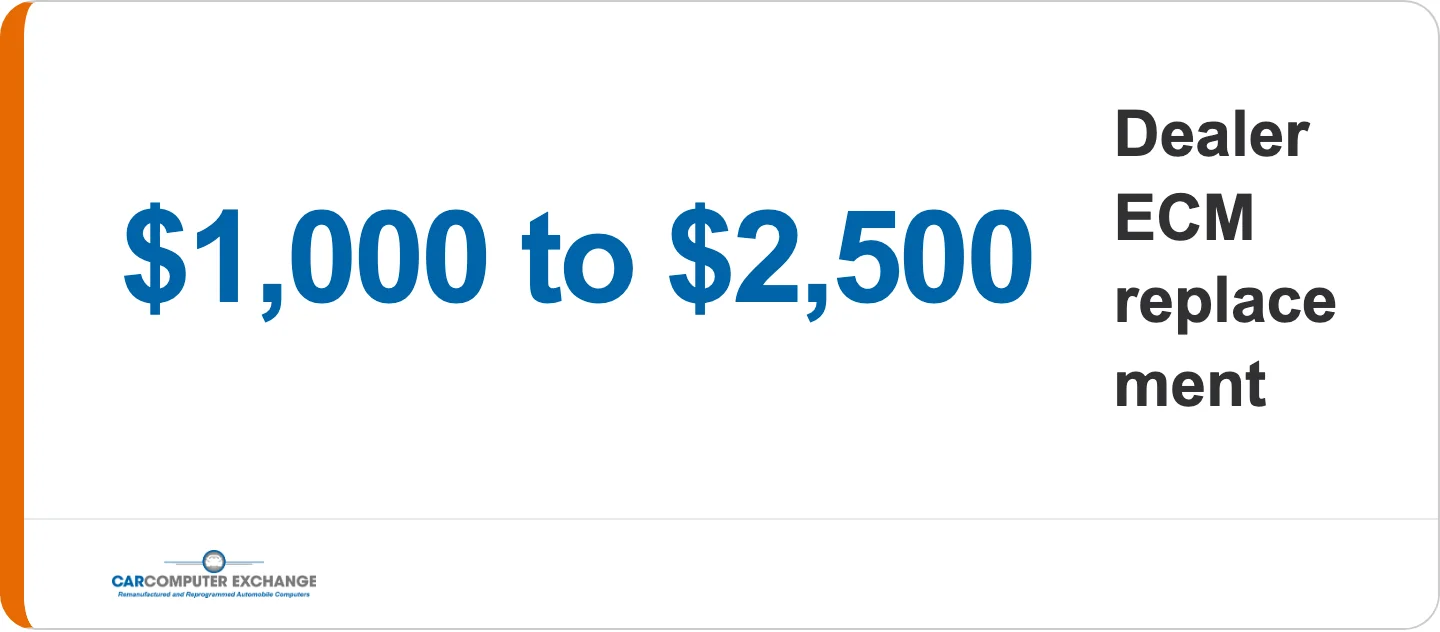
Full ECM replacement with dealer programming, for most gas vehicles.
DIY vs. Professional ECM Reflashing
ECM reflashing is a task some vehicle owners can do at home, but it requires preparation and specific equipment.
DIY reflashing makes sense when:
- You own a J2534 pass-through device or are willing to invest in one
- You have a Windows laptop and reliable internet connection
- You can purchase a session pass for the OEM’s software platform
- You are comfortable working with diagnostic software and following technical procedures
- You have a battery charger to maintain stable voltage during the flash
Hire a professional when:
- The vehicle needs immobilizer or anti-theft reprogramming (often requires dealer-level scan tools)
- You are reflashing a diesel platform with specialized protocols
- You have no experience with OBD-II tools or diagnostic software
- The dealer has a TSB or recall requiring their specific programming procedure
Consider a pre-programmed replacement when:
- The ECM hardware is physically damaged or showing symptoms of failure (not just a software issue)
- The dealer refuses to reflash an older vehicle (some dealerships decline work on vehicles outside their current service range)
- The combined cost of diagnostic fees, programming fees, and labor at a dealer exceeds the cost of a replacement module
- You want to avoid the risk of bricking a working ECM during a reflash attempt
ECM Reflashing vs. Replacement: When Each Makes Sense
Reflashing and replacement solve different problems. The right choice depends on whether the issue is software or hardware.
Reflash the existing ECM when:
- The ECM hardware is functioning correctly but running outdated or corrupted software
- A manufacturer TSB requires an updated calibration file
- You replaced a major engine component and the ECM needs recalibration
- The vehicle failed emissions due to software parameters, not hardware faults
Replace the ECM when:
- The ECM has physical damage (water intrusion, burned circuits, corroded connectors)
- Diagnostic testing confirms a hardware failure inside the module
- The vehicle needs a module matched to a different VIN (you cannot reflash an ECM designed for one vehicle to work in another; the calibration must match the exact year, make, model, and engine)
- Reflashing has already been attempted and the problem persists
Car Computer Exchange provides remanufactured, VIN-programmed engine computers that ship ready to install. Every module goes through a 13-point quality check on a computer-aided vehicle simulator that tests engine, transmission, emissions, and anti-theft circuits under load. The company has served over 150,000 customers since 2011 and holds 4,500+ customer reviews.
For vehicles where repair or replacement is the better path, a pre-programmed module eliminates the need for dealer programming fees and the risk of bricking during a reflash.
Frequently Asked Questions
How much does it cost to have an ECM flashed?
A basic ECM reflash at an independent shop costs $150 to $300. Dealer reprogramming runs $200 to $600 for the programming, plus a potential diagnostic fee of $100 to $200. Full ECM replacement with programming at a dealer costs $1,000 to $2,500 for most gas vehicles.
How long does it take to flash an ECM?
The actual flash process takes 5 to 30 minutes depending on the vehicle platform and file size. Including setup, diagnostic scan, calibration file download, DTC clearing, and idle relearn, a full reflash appointment takes 1 to 2 hours. Diesel platforms with larger calibration files may take longer.
Can you tell if an ECU has been flashed?
Yes. A diagnostic scan tool can read the calibration file version currently installed on the ECM. Comparing this version number to the original factory calibration reveals whether the module has been reflashed with a newer or modified file. Some OEM software platforms also log the date and method of the last programming event.
What happens if an ECM flash fails?
A failed flash can brick the ECM, leaving it non-functional. The most common causes are power interruption during the write process, using the wrong calibration file, or a corrupted download. Some bricked modules can be recovered through bench flashing by a specialist. Others cannot be recovered and must be replaced. Using a battery charger, verifying the calibration file before flashing, and maintaining a stable internet connection during the download are the three best prevention steps.
Does reflashing an ECM void the warranty?
OEM-approved reflashing using manufacturer software and calibration files does not void a vehicle’s warranty. Unauthorized performance tuning or aftermarket calibration modifications may affect warranty coverage for related components. Replacing a faulty ECM with a factory-spec module programmed to the original manufacturer calibrations does not affect the vehicle’s existing warranty coverage.
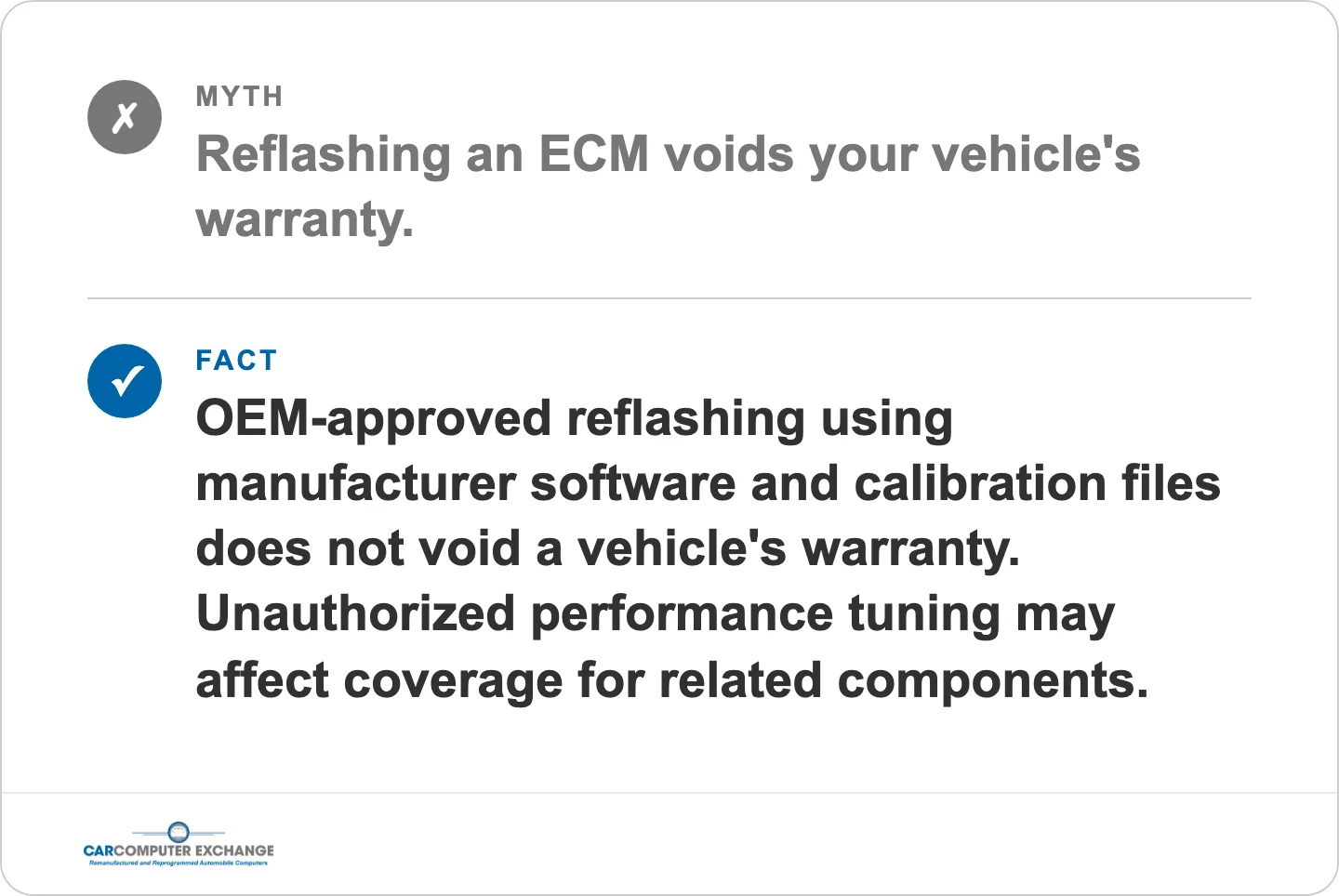
The distinction is OEM-approved calibration versus aftermarket performance tuning.
Conclusion
ECM reflashing updates your engine computer’s software without replacing the hardware. It requires a J2534 pass-through device, OEM-specific software, and a stable power source to prevent bricking. The process follows six steps: connect, key on, select the calibration file, flash, clear codes, and relearn.
For vehicles with functioning ECM hardware that just need updated software, reflashing at a shop typically costs $150 to $300 at an independent shop or $200 to $600 at a dealer. For vehicles with hardware damage or failed modules, a pre-programmed replacement is typically faster and cheaper than dealer diagnosis plus programming.
Car Computer Exchange ships remanufactured engine computers pre-programmed to your VIN with the latest factory software. Each module passes a 13-point quality check on a vehicle simulator and includes a free lifetime warranty with core return. Enter your year, make, and model to find your replacement module.