How to Reset a Jeep ECU in 2026 (Safe Step-by-Step Guide)
Your Jeep’s warning light stays on after a battery change or a recent repair. The idle may feel rough, or the vehicle may shift differently than it did before. At that point, many owners start searching for how to reset a Jeep ECU.
The quickest fix is to disconnect the negative battery cable for about 15 minutes, then reconnect it and start the engine. A reset clears stored codes and lets the computer relearn the idle and shift settings it builds up over time. It does not repair anything mechanical or electrical, so if the same symptom comes back within a day or two, the real fault is still there.
This guide explains how to reset a Jeep ECU safely, when the reset actually helps, the battery and fuse methods, and what to do when a reset is not enough.
Key Takeaways
- A reset clears memory, not faults. Disconnecting the battery or pulling the PCM fuse wipes stored codes and learned settings, but it repairs nothing. A symptom that returns quickly means the underlying problem is still there.
- There are two safe DIY methods. The battery-disconnect method is the most common. Pulling the PCM fuse does the same job on many Jeeps without erasing your radio presets and clock.
- A reset will not clear an anti-theft no-start. Jeep’s Sentry Key system locks out the engine until the computer and keys recognize each other. A plain reset does not re-pair them.
- Expect a short relearn period. After any reset, the computer needs about 50 to 100 miles of normal driving to relearn idle and shift behavior.
- A reset can affect an emissions inspection. It erases the OBD-II readiness monitors a smog test checks, so time it carefully before an inspection.
How to Reset a Jeep ECU Quickly
The fastest way to reset a Jeep ECU is to disconnect the negative battery cable for about 15 minutes, then reconnect it and start the engine. You can also use an OBD-II scan tool to clear stored trouble codes without disconnecting the battery, and some scan tools will reset certain learned values depending on the Jeep and the tool.
The battery method wipes the module’s short-term memory, including stored trouble codes, fuel trim adjustments, and the idle settings it learned over time. A scan tool clears the stored codes, but it only resets those learned values if the tool has a reset function, so the battery disconnect is the more complete reset. After you reconnect power, turn the key to the on position for about 30 seconds before starting so the computer can run its self-check.
A reset does not repair anything mechanical or electrical. If a warning light or rough idle comes right back after the reset, that is usually a sign the underlying problem is still there.
When a Jeep ECU Reset Helps
A reset helps most after routine work, a battery change, or a temporary fault that has already been repaired. Replacing the battery already disconnects power, which may clear stored codes and learned settings. If you go that route, your Jeep may need time to relearn some driving behavior afterward.
A reset also helps after a small, one-time code, like one triggered by a loose gas cap or a brief sensor glitch that already cleared on its own. It can smooth out a rough idle or hesitant shifting after a repair, since the computer needs a short drive to relearn how your Jeep normally runs. This applies across the lineup, from a Wrangler JK or JL to a Grand Cherokee.
If you are working on a Jeep Wrangler PCM replacement or a similar swap, the same relearn period applies once the new module is installed and powered up for the first time.
Will a Reset Actually Fix It? A Quick Cheat Sheet
Not every problem calls for a full reset. Use this quick reference to see what fits your situation.
| Situation | Will a reset help? | What to do |
|---|---|---|
| Battery was replaced or disconnected | Yes, sometimes | Reset the ECU, then drive normally so the Jeep can relearn idle and shift behavior |
| Check engine light appeared after a repair | Maybe | Clear the code with a scan tool or battery reset, then see if it comes back |
| Jeep idles rough after routine work | Sometimes | Reset the ECU and give it a short relearn period before assuming something is broken |
| Same code returns quickly | No, not by itself | Diagnose the sensor, wiring, connector, or module issue causing the code |
| Jeep won’t start | Usually no | Check the battery, starter, fuses, grounds, security system, and PCM or ECU communication before replacing parts |
| Failed emissions readiness test | No, a reset can make this worse | Drive enough to complete the OBD-II readiness monitors before an inspection |
| ECU or PCM has failed internally | No | Replace the module with a programmed unit matched to the vehicle |
Steps to Reset Your Jeep’s ECU
Here is the safe way to do a battery reset, in order, so you do not skip a step that matters.
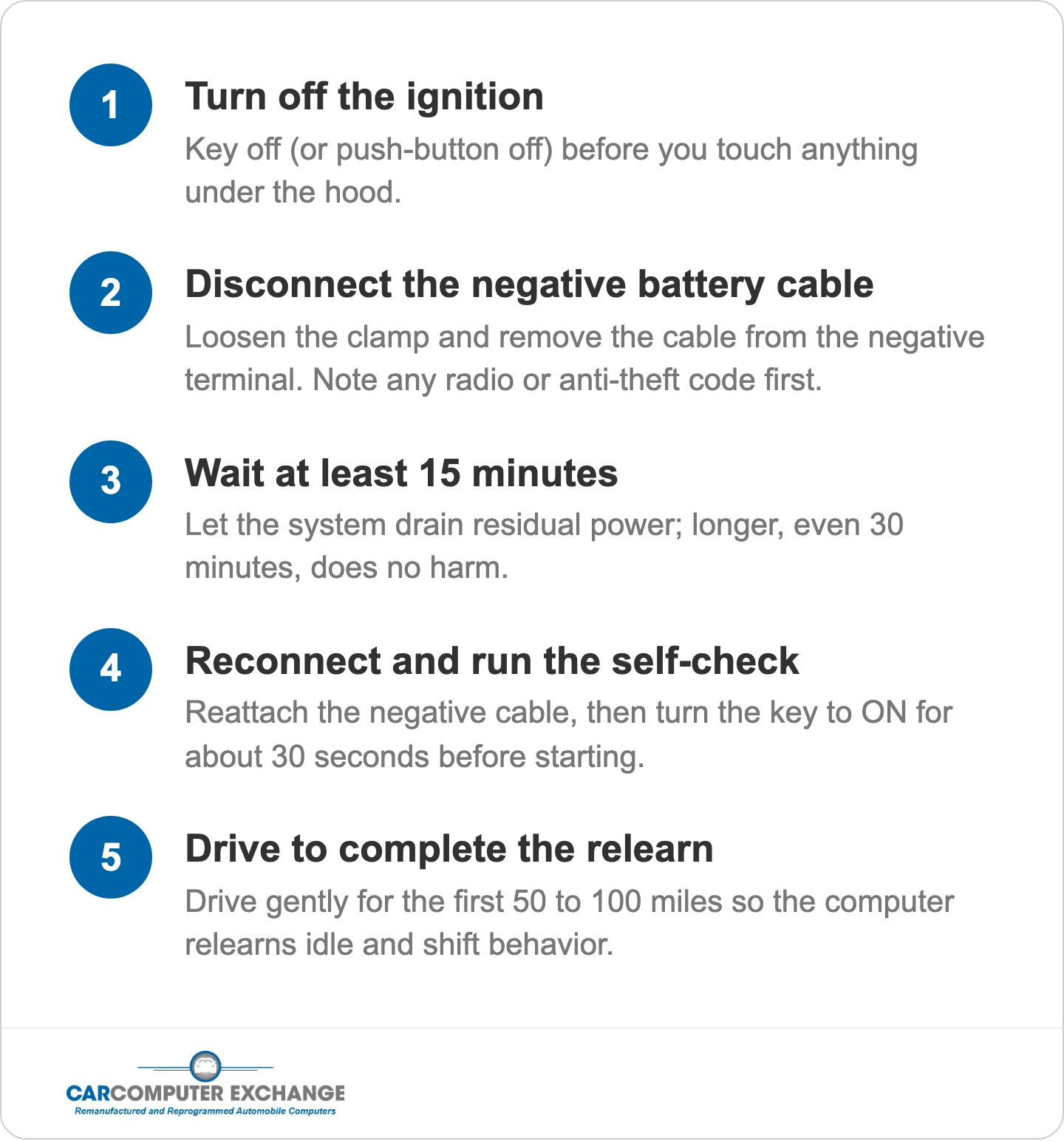
The safe battery-disconnect reset, in order. Source: Car Computer Exchange.
1. Turn Off the Ignition First
Turn the key off, or shut off the ignition button if your Jeep has push-button start, before you touch anything under the hood. Working on the battery with the ignition on risks a short circuit or a fault code you did not have before.
2. Disconnect the Negative Battery Cable
Loosen the clamp and remove the cable from the negative battery terminal. Disconnecting the negative alone is enough to cut power to the computer. The negative terminal is usually marked with a minus sign and usually has a black cable, while the positive side has a red cable and a plastic cover. If you do remove both cables, take the negative off first and put it back on last, so a slipped wrench on the positive terminal cannot short against the body. Before you disconnect anything, note your radio or anti-theft code if your Jeep uses one, since the reset can clear it. Always check your owner’s manual to be sure.
3. Wait at Least Fifteen Minutes
Give the electrical system time to fully drain any residual power. Fifteen minutes is a safe minimum for most Jeeps. Waiting longer, even up to a half hour, will not cause any harm if you are not in a rush.
4. Reconnect the Cable and Run the Self-Check
Reattach the negative cable and tighten the clamp so it is snug. Before you start the engine, turn the key to the on position for about 30 seconds without cranking, so the computer can power up and run its self-check. Then start the engine as normal. The idle may feel a little rough at first. You may also need to reset the radio, clock, and window auto-up features separately.
5. Drive to Complete the Relearn
Drive normally for 10 to 15 minutes, covering some stop-and-go traffic and some steady highway speed if you can. Keep the acceleration gentle for the first 50 to 100 miles. This lets the computer relearn idle speed and shift patterns instead of running on default settings until it catches up.
Reset the PCM With the Fuse Instead
On many Jeeps, you can reset the computer by pulling the fuse or relay that feeds the PCM instead of disconnecting the battery. The advantage is that this method often leaves the radio presets, clock, and seat memory untouched, since the rest of the vehicle keeps power.
Here is the safe way to do it:
- Turn the ignition off and open the fuse box. Your owner’s manual lists the fuse box locations and labels.
- Find the fuse or relay labeled for the PCM, ECM, or engine computer. Fuse layouts vary by model and year, so confirm it against the manual before pulling anything.
- Pull the fuse with a fuse puller and leave it out for about 15 minutes so the computer loses power and clears its short-term memory.
- Reinsert the fuse, close the box, turn the key to the on position for about 30 seconds, then start the engine and complete the same relearn drive described above.
On some older Wranglers this is the quicker route. On newer Jeeps with more complex networks, the computer may hold some data regardless, so the battery method is the more thorough reset.
What a Reset Won’t Fix
A reset clears data. It does not repair damaged circuits, failed communication, or a module that has stopped working internally. If the same code or symptom returns within a day or two of resetting, that is usually a sign of a real fault, such as a failing sensor, a wiring or ground problem, or a module that is on its way out.
When the module itself has failed, a reset cannot bring it back. A failed computer has to be programmed to your Jeep first: paired to the VIN, matched to the anti-theft data and key codes, and given the right emissions calibration, or the engine will not accept it. A reset does none of that, which is why a bad computer still will not start the Jeep after a battery disconnect. In that case the fix is a programmed replacement Jeep module matched to your vehicle, not another reset.
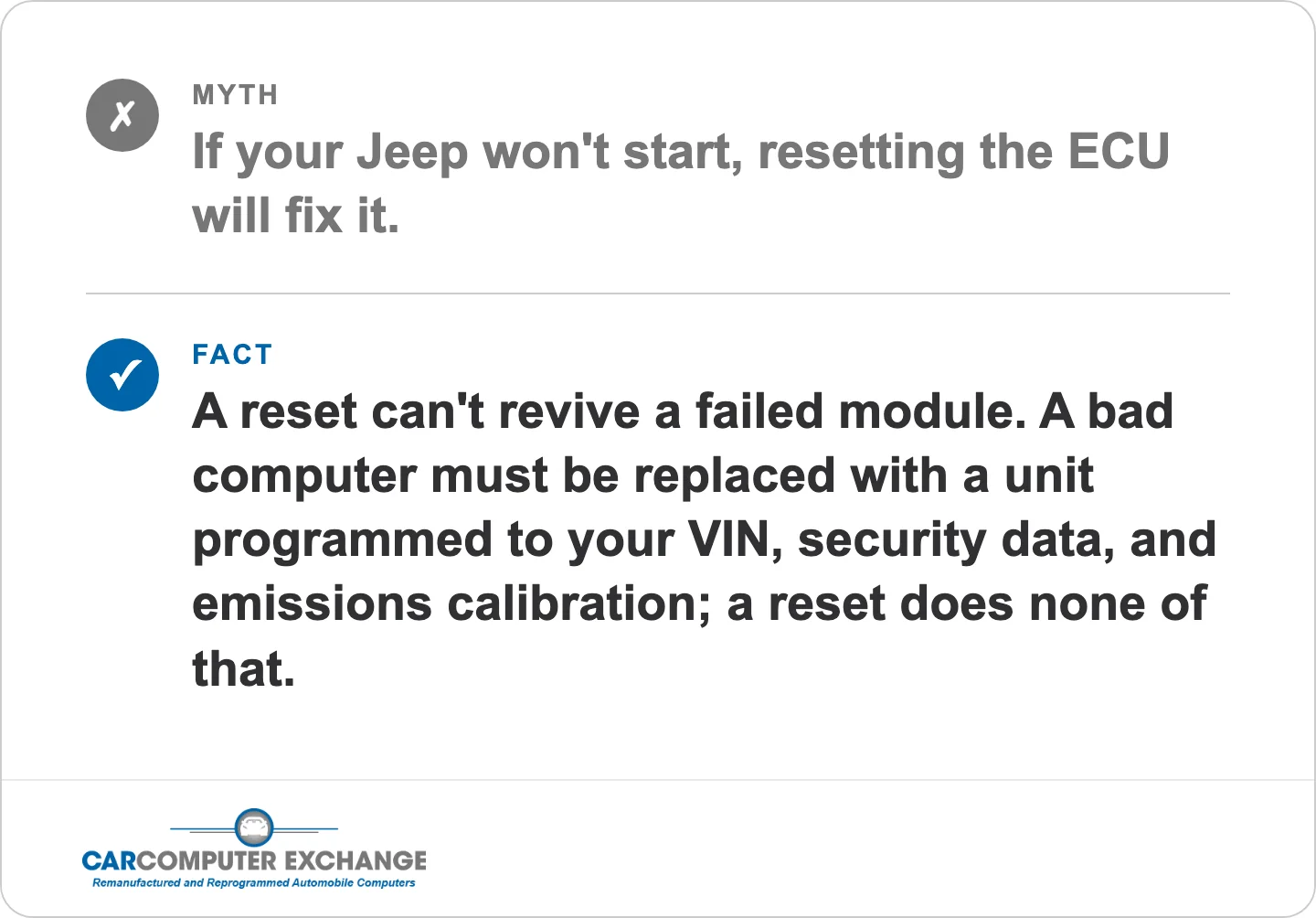
When the module has failed, a reset can’t bring it back. Source: Car Computer Exchange.
Why a Reset Won’t Clear a Jeep Anti-Theft No-Start (Sentry Key / SKIM)
A reset will not get your Jeep out of an anti-theft no-start. Jeep, Dodge, and Chrysler vehicles from 1998 to 2017 use a Sentry Key Immobilizer Module, often called SKIM, that keeps the engine from running until the computer and the keys recognize each other. If the computer and key data do not match, the Jeep may crank, start, and stall, or refuse to start at all.
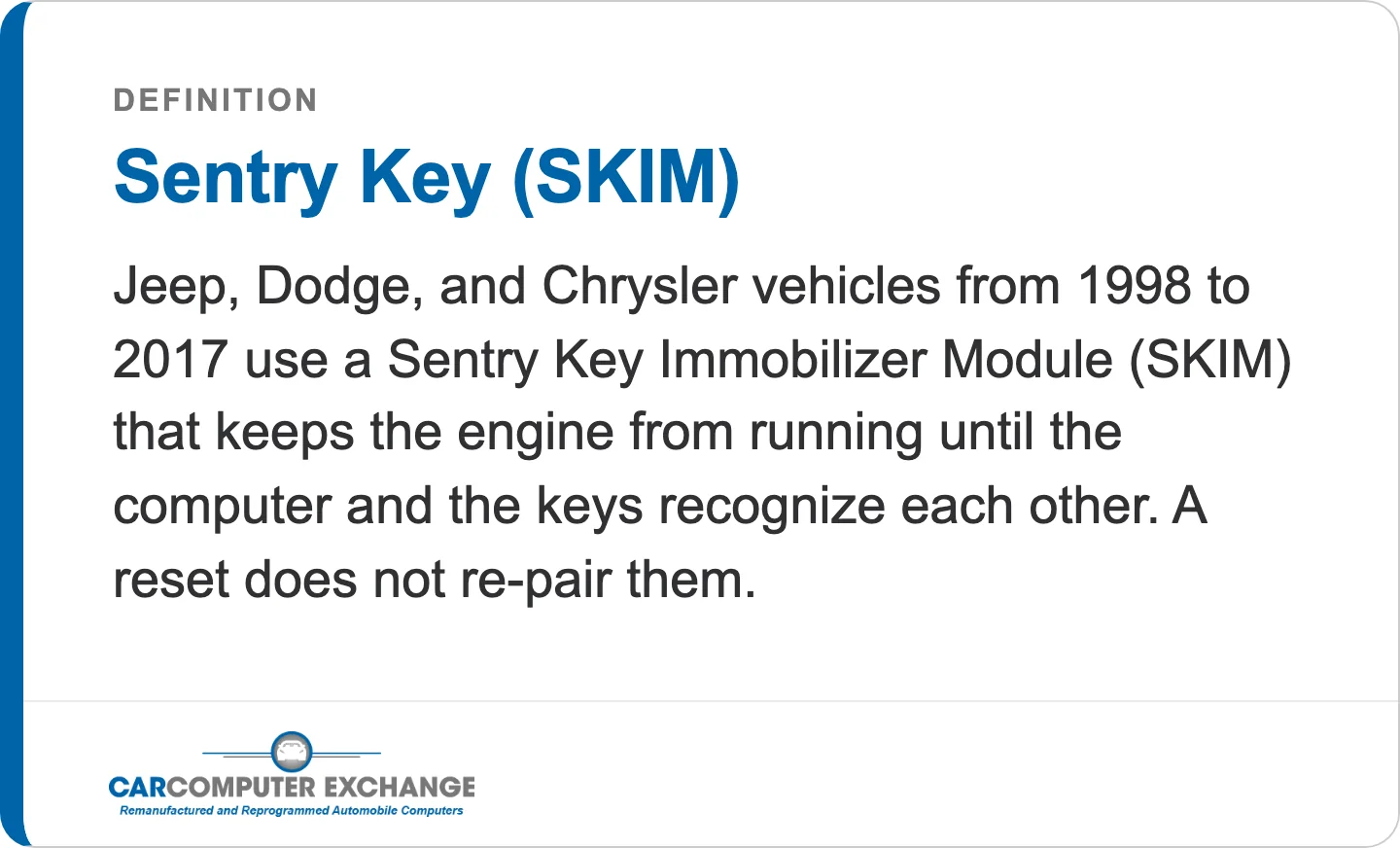
Jeep’s anti-theft system, and why a reset can’t clear it. Source: Car Computer Exchange.
Disconnecting the battery or pulling a fuse clears stored codes and learned values. It does not re-pair the keys to the module and it does not reprogram the immobilizer. That key and security sync is a separate operation from a reset.
This matters most when a module has been replaced. A replacement Jeep PCM or ECM has to be matched to the vehicle’s VIN and security data, or the engine may crank without starting. On some Jeeps a replacement also needs a key or security relearn after it is installed, and on others it does not, so the product listing spells out what that specific module includes. The same security system is shared across the platform, so the same rule applies to Dodge and Chrysler vehicles of the same era. A plain reset is never a substitute for correct programming.
Resetting Affects Your Emissions Monitors Too
A reset also clears your Jeep’s OBD-II readiness monitors, the same ones an emissions inspection checks. In states that run OBD-II emissions inspections, such as New York, a vehicle will not pass unless the required monitors show as ready, and a recently disconnected or replaced battery is a common reason they don’t.
If you are due for an inspection soon, timing matters just as much as knowing how to reset a Jeep ECU. Give the Jeep a few days of normal, varied driving first so the readiness monitors have time to complete their tests. Otherwise, you may need to reschedule.
Get Your Jeep Running Right Again
Knowing how to reset a Jeep ECU can help after a battery change, a recent repair, or a temporary code. If the same warning light or driving problem returns, the next step is a proper diagnosis so you can find the real cause and avoid repeating a reset that will not solve the problem.
Car Computer Exchange supplies programmed ECMs and PCMs for Jeep, matched to your vehicle’s VIN and details. Each listing shows the testing, programming, and warranty terms that apply to that exact module. When a reset does not fix the problem and the module has failed, a programmed replacement is the fix.
Browse Jeep modules to find the right match, or enter your year, make, and model to see the exact unit for your vehicle. Need help? Call the number at the top of this page or email sales@carcomputerexchange.com, and ask for the English or Spanish line.
Frequently Asked Questions
Does disconnecting the battery reset the ECU?
Yes, disconnecting the negative battery cable can reset a Jeep ECU by clearing stored codes and adaptive values. It does not repair a bad ECU, a failed sensor, a wiring issue, or a mechanical problem. If the same warning light or symptom comes back, the Jeep needs diagnosis instead of another reset.
How long should I disconnect the battery?
Disconnect the negative battery cable for at least 15 minutes when resetting a Jeep ECU. Some owners wait longer, but the bigger point is making sure the ignition is off and the cable is safely disconnected. After reconnecting the battery, the Jeep may need time to relearn idle and driving behavior.
Is there a fuse to reset the Jeep computer?
Yes, on many Jeeps you can pull the fuse or relay that feeds the PCM for about 15 minutes instead of disconnecting the battery. This clears the computer’s short-term memory and often keeps your radio presets and clock intact. Check your owner’s manual for the exact fuse location before pulling anything, since layouts vary by model and year.
Will resetting clear a check engine light?
Resetting a Jeep ECU may clear a check engine light if the issue was temporary or has already been repaired. If the fault is still there, the light will usually come back. A reset clears the warning, but it does not fix the cause behind the code.
Will a reset get my Jeep out of anti-theft (Sentry Key) mode?
No, a reset does not clear a Jeep anti-theft no-start. The Sentry Key system locks out the engine until the computer and keys recognize each other, and a battery or fuse reset does not re-pair them. If the Jeep cranks but will not start after a module change, the computer most likely needs to be matched to the vehicle’s VIN and security data.
Can a bad ECU be fixed by resetting?
No, a bad ECU cannot usually be fixed by resetting it. A reset can clear stored data or force a relearn, but it will not repair damaged circuits, failed communication, corrosion, or internal module failure. If the ECU is truly bad, replacement is usually the real fix.
About Brian
Diagnosing, repairing, and reprogramming the “digital brains” of modern vehicles. Years of specialized experience in ECM/PCM electronics and advanced automotive diagnostics. Making complex car tech simple.
Sources