5 Reasons Your Car Is Stuck in Limp Mode (2026 Guide)

Your car suddenly loses power. The RPMs will not climb, the transmission may stop shifting normally, and a warning light appears on the dashboard. That usually means the vehicle has dropped into limp mode.
A car stuck in limp mode is running in a protective state: the onboard computer has detected a fault that could damage the engine or transmission, so it caps power and speed to get you off the road safely. Most cases trace back to one of five things: low or dirty transmission fluid, a bad sensor, engine overheating, damaged wiring, or a failing ECU or PCM.
This guide covers what limp mode means, the signs to look for, how to get your car out of it, and how to find the actual cause before you spend money on the wrong repair.
Key Takeaways
- Limp mode is protection, not a breakdown. The car’s computer caps power and can lock the transmission in one gear to prevent damage after it detects a fault.
- Most cases come down to five causes: low or dirty transmission fluid, a bad sensor, engine overheating, damaged wiring, or a failing ECU or PCM.
- The symptoms cluster together: reduced power and speed, a low RPM ceiling, the transmission stuck in one gear, and a dashboard warning light.
- A restart can clear it, but that is not a repair. If the underlying fault is still active, limp mode comes back.
- When fluid, sensors, cooling, and wiring all check out, the control module itself is the remaining suspect.
What Limp Mode Actually Means
Limp mode is a protective setting the car’s computer switches on when it detects a problem that could damage the engine or transmission. The car limits power, caps RPM, or holds one gear so you can move it somewhere safe. Mechanics also call it limp-home mode or failsafe mode.
There are two broad versions. Engine limp mode comes from the engine control side, the ECM or PCM, and usually caps power and throttle response. Transmission limp mode comes from the transmission control side, the TCM or PCM, and usually locks the gearbox in a single low gear so the transmission stops shifting.
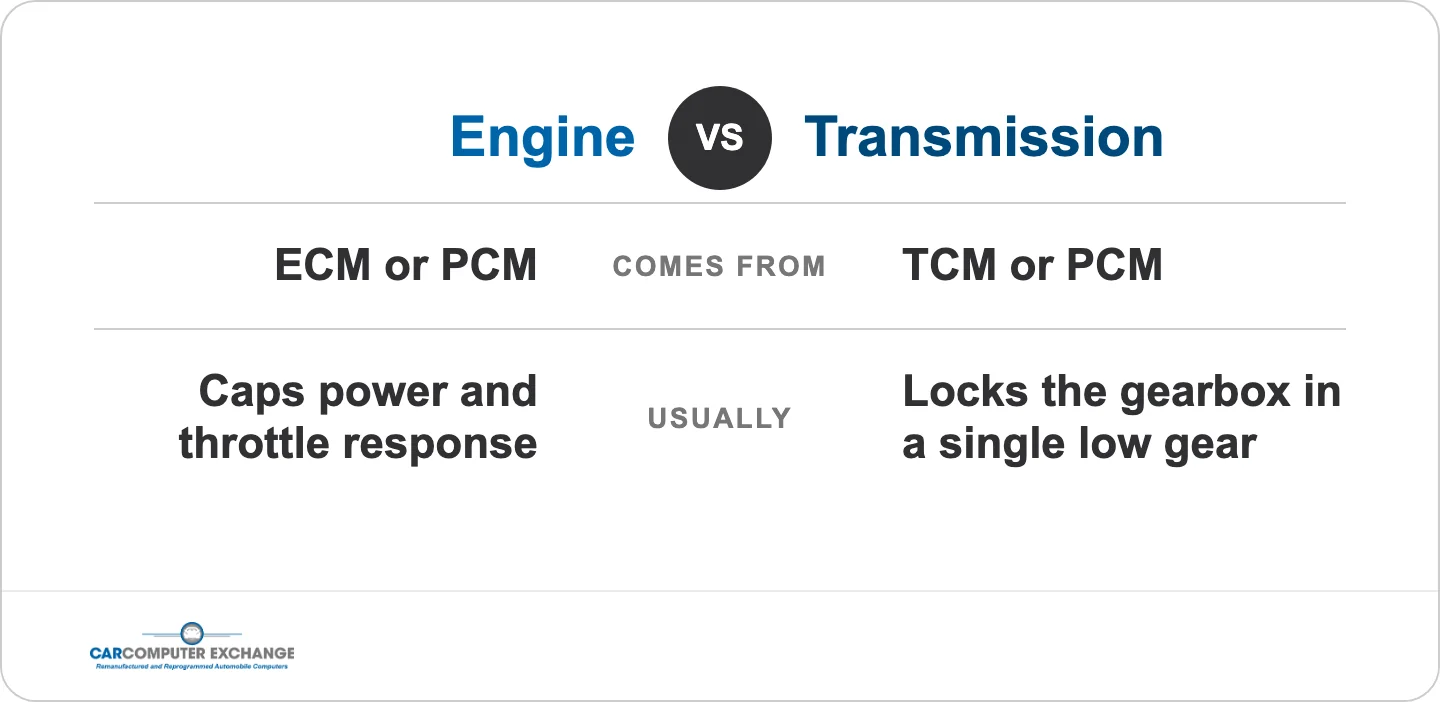
Engine limp mode caps power and throttle response, while transmission limp mode locks the gearbox in a single low gear.
Limp mode is common enough that automakers have recalled vehicles over it. A 2021 recall (NHTSA campaign 21V-234) covered certain Infiniti Q50 and Q60 models whose engine control module software could put the car into limp-home mode and, in some cases, stall the engine. Federal regulators had earlier opened an investigation (PE13-003) into 2009 to 2013 Ford Escape and Fusion models after electronic throttle body faults caused sudden power loss and a limp-home condition. Limp mode is a real safety response, not a glitch to ignore.
Signs Your Car Is in Limp Mode
You can usually tell a car is in limp mode by how it drives. The computer holds the vehicle in a reduced-power state, so the symptoms tend to show up together rather than one at a time.
- Reduced power and speed. The car struggles to accelerate and often will not climb to normal highway speeds.
- Low RPM ceiling. The engine will not rev past a reduced limit the computer sets, so it feels gutless under throttle.
- Stuck in one gear. An automatic transmission stops shifting and holds a single low gear.
- Warning light on. The check engine light, a transmission warning light, or a reduced-power message appears on the dash.
- Sluggish throttle. Pressing the pedal produces weak or delayed response.
A flashing check engine light is more serious than a steady one. It usually signals an active misfire, so stop driving and get the car looked at.
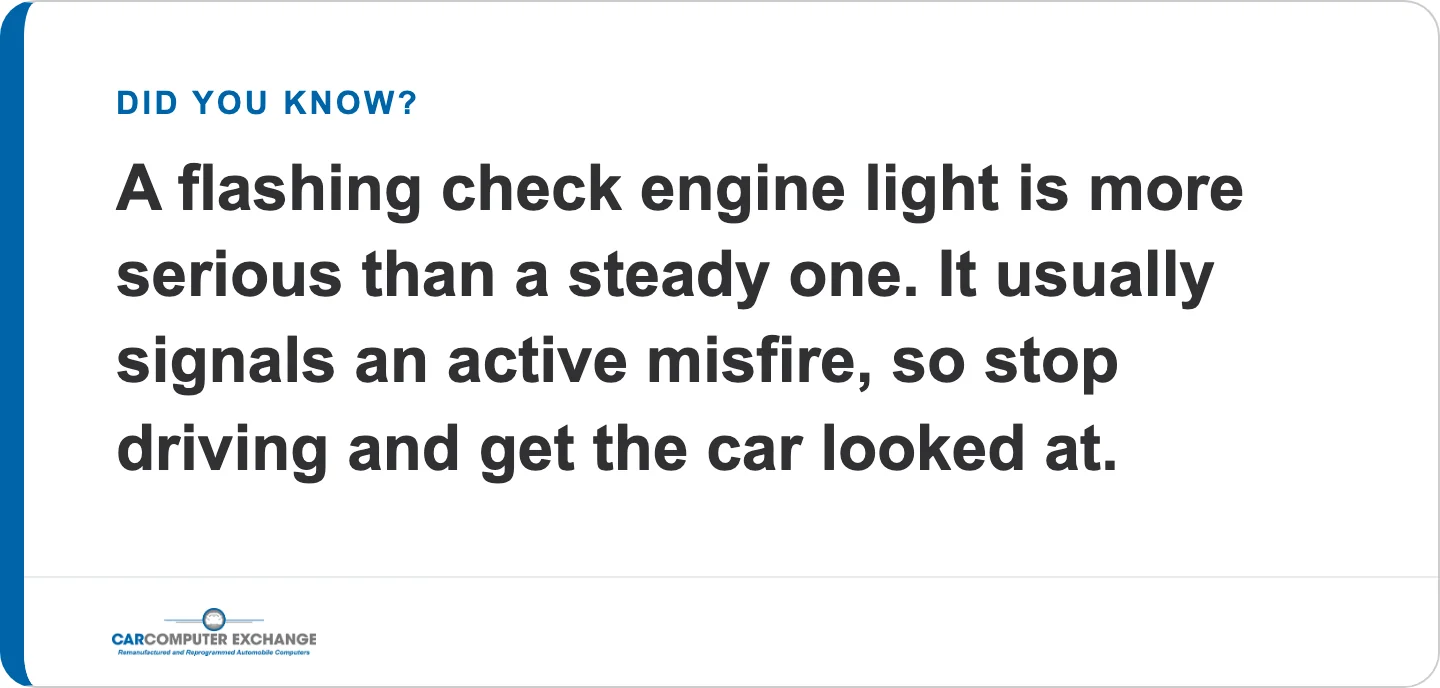
A flashing check engine light usually signals an active misfire, so it calls for stopping, not driving on.
Limp Mode Causes at a Glance
Use this table to get a rough sense of what is behind yours, then read the cause-by-cause breakdown for how to confirm and fix each one.
| Possible cause | Why it can trigger limp mode | What to check first |
|---|---|---|
| Low or dirty transmission fluid | The transmission may not have the pressure or lubrication it needs, so the car limits power to protect itself | Check the fluid level, color, smell, and service history |
| A sensor sending bad signals | A faulty sensor can send the ECU incorrect information about throttle position, air flow, speed, or engine load | Scan for codes tied to the throttle position sensor, MAF sensor, speed sensor, or related wiring |
| Engine overheating | The car may reduce power to prevent more serious engine damage | Check coolant level, temperature gauge, radiator fans, thermostat, hoses, and water pump |
| Wiring or connector damage | Corroded, loose, or damaged wiring can interrupt communication between the ECU and key systems | Look for corrosion, loose plugs, damaged harnesses, rodent damage, or wires near heat and moving parts |
| Bad ECU or PCM | If the control module fails or stops communicating correctly, it may put the car into limp mode even after simpler causes are ruled out | Check for internal module codes, no communication, repeated limp mode, and symptoms that remain after fluid, sensors, cooling, and wiring are tested |
5 Things That Put a Car in Limp Mode
Here is a closer look at each cause, how to tell it is the one you are dealing with, and what actually fixes it.
1. Low or Dirty Transmission Fluid
Low or dirty transmission fluid is one of the most common reasons a car ends up in limp mode. The transmission needs fluid at the right level and in good condition to build pressure and shift properly. When the fluid runs low, breaks down, or the filter clogs, the transmission cannot hold pressure, so the computer limits power to protect the gears. This is the classic cause of transmission limp mode.
How to tell. Watch for harsh or delayed shifting right before limp mode kicks in, a burnt smell or dark fluid on the dipstick, or a whine from the transmission. This cause usually builds gradually rather than appearing out of nowhere.
The fix. Check the fluid level and condition first. If it is low, find the leak before topping off with the correct fluid. Dirty or worn fluid usually needs a fluid and filter service. After the repair, test drive the car and watch for returning warning lights or shifting problems.
2. A Sensor Is Sending Bad Signals
A failing sensor can push a car into limp mode by feeding the computer bad data. Sensors such as the throttle position sensor, the mass airflow (MAF) sensor, the manifold pressure (MAP) sensor, the oxygen (O2) sensor, and the speed sensors send a constant stream of readings to the ECU. When one reading is missing or wrong, the computer can no longer control the engine safely, so it limits power.
How to tell. A scan tool usually shows a code tied to a specific sensor. Symptoms that come and go with vibration or engine temperature also point toward a sensor or its wiring.
The fix. Test the sensor, its wiring, and its connector against the stored code. Once the fault is repaired, clear the code and take a test drive to confirm it does not return.
3. The Engine Is Overheating
When coolant temperature climbs too high, your car reduces power to lower the load on the engine. This safety mechanism prevents serious damage like a warped head or a blown gasket.
How to tell. A rising temperature gauge, steam from under the hood, or a low coolant reservoir are the clearest signs. Because overheating can cause serious engine damage, pull over safely and let the engine cool before checking the cooling system.
The fix. Let the engine cool down before doing anything else, then check the coolant level and look for the source. The problem could be a failing thermostat, a weak water pump, a clogged radiator, or a leaking hose. Fixing that root cause is what clears the condition.
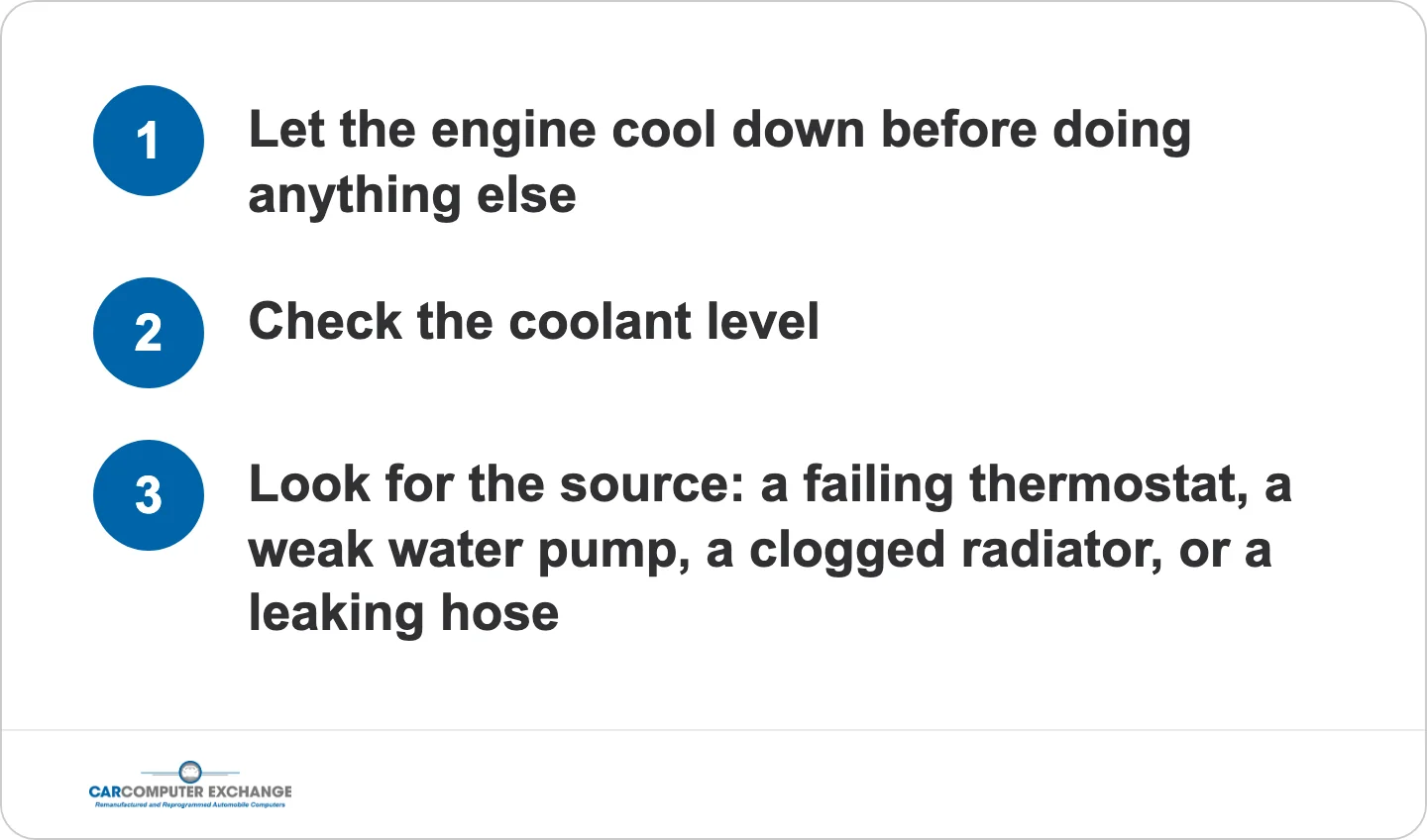
When overheating triggers limp mode, let the engine cool, check the coolant, then find the root cause, since fixing it is what clears the condition.
4. Wiring or Connector Damage
Corroded, loose, or damaged wiring can interrupt the signals the computer relies on and trigger limp mode. When a connection breaks down, the ECU loses communication with other systems, and the problem often comes and goes as the car moves.
How to tell. Watch for symptoms that shift with bumps, vibration, or temperature. Look for corrosion, chew marks, or loose plugs around the engine bay. A weak battery or failing alternator can mimic the same electrical faults, so a quick battery and alternator load test, which most auto parts stores can do for you, is a cheap way to rule out a charging problem before you dig into the harness.
The fix. Repair damaged wires, clean or replace corroded connectors, and secure loose harnesses away from heat and moving parts. Many of these repairs are simple once the problem is traced, even though the diagnosis takes patience.
5. A Bad ECU or PCM
Sometimes the computer running the system is the problem. Internal faults, corrupted memory, or a control module that has lost communication can trigger limp mode as a default protective response, even after everything mechanical checks out. This is the cause most drivers do not expect, since it is easy to assume the trouble is mechanical.
When a module fails internally, no amount of sensor or fluid work will clear the condition. The same bad ECM symptoms keep returning until the module itself is addressed.
How to tell. Look for internal module fault codes, no communication at all from the scan tool, or limp mode that keeps returning after fluid, sensors, cooling, and wiring have all checked out.
The fix. A reset clears codes temporarily, but it does not repair internal damage inside the module. Once a shop confirms the ECU or PCM is the source, the module has to be rebuilt or replaced with a properly programmed unit so it communicates with the rest of the car. A reset alone will not hold.
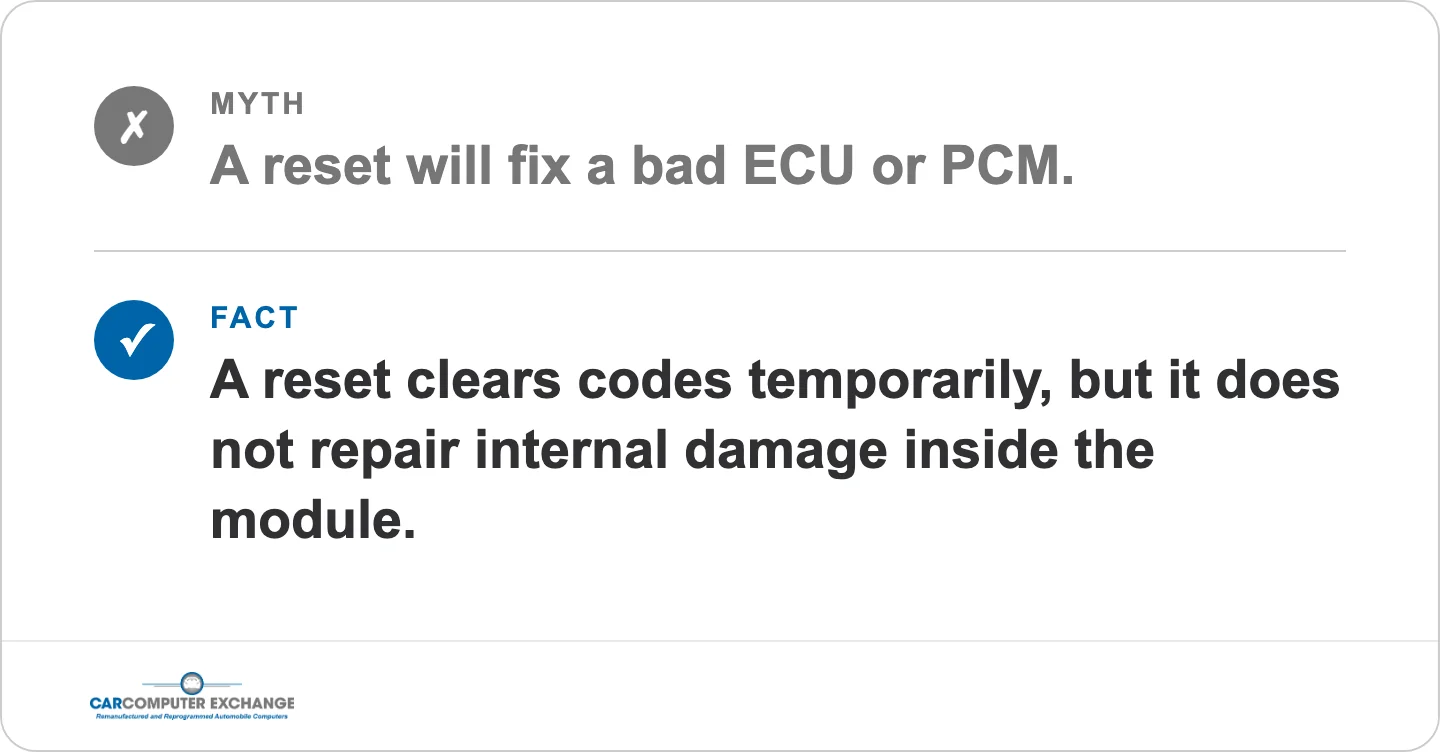
Resetting a failing ECU or PCM clears the codes for a while, but it does not repair internal damage, so limp mode keeps coming back.
How to Get Your Car Out of Limp Mode
Getting a car out of limp mode means fixing what triggered it. A restart may clear the warning for a short time, but limp mode returns if the fault is still active. Work through these steps in order.
- Pull over safely and note what the car is doing. Get out of traffic, then take note of the warning lights and how the car is behaving. That information helps a technician later.
- Turn the engine off, wait, and restart. Shut the car down for about a minute, then restart it. This clears a temporary glitch in some cases. Treat it as a way to get moving, not a repair.
- Check your fluids. Look at the transmission fluid and engine oil on their dipsticks. Low or dirty fluid is a common trigger, and topping off the correct fluid can release limp mode if that was the cause.
- Load-test the battery and charging system. Voltage problems from a weak battery or failing alternator can look like an electrical fault and set off the same protection. Most auto parts stores can test both for you.
- Scan for trouble codes. Use an OBD-II scanner to read the stored codes across all modules, not just the engine. Write the codes down before clearing anything, since they tell you and the mechanic what failed.
- Fix the root cause or see a professional. If fluids, battery, and a basic scan do not solve it, have a shop diagnose the exact fault. Clearing a code without fixing the cause only turns the light off until limp mode returns.
Scan for Trouble Codes First
When a car is stuck in limp mode, the fault is usually stored as one or more trouble codes in the car’s computer. Reading those codes is the fastest way to find out which system triggered the protection, so start there before replacing parts.
A basic code reader may only show engine codes. A full scan tool reads the transmission, ABS, and body modules too, which matters because limp mode can start in any of them. For how to read and clear these codes, see our guide to car computer codes and what to do when a scan tool shows no communication.
A full scan tool reads the transmission, ABS, and body modules, not just the engine, which matters because limp mode can start in any of them.
Get the Right Fix for Your Limp Mode Problems
Limp mode always means something is wrong, even when the fix turns out to be simple. The cause can be as cheap as a fluid top-off or as involved as a full module replacement. That is why a real diagnosis matters before you spend money on the wrong part.
When the computer itself is the cause, we can help. Car Computer Exchange handles PCM and ECM units for domestic and diesel platforms, whether your vehicle needs a pre-programmed replacement or a send-in repair. Enter your year, make, and model on our vehicle lookup to see the option for your module, or reach our team using the number at the top of this page. We answer in English and Spanish, Monday through Friday, 9am to 6pm Eastern.
Frequently Asked Questions
What does it mean when a car is stuck in limp mode?
A car stuck in limp mode is limiting its own power because the computer detected a problem that could affect safety, drivability, or major components. You may notice reduced speed, capped RPM, harsh shifting or a gear that will not change, and a warning light. Limp mode is a warning, not a repair.
Can low transmission fluid cause limp mode?
Yes, low or dirty transmission fluid can cause limp mode because the transmission may not have the pressure or lubrication it needs to shift safely. This is one of the first things to check, since it is often simpler and cheaper than replacing sensors, wiring, or a control module.
Is it safe to keep driving in limp mode?
You should not keep driving far in limp mode. It may be safe enough to move out of traffic or reach a nearby repair shop, but limp mode means the car is protecting itself from a problem. Continuing to drive can make the underlying issue worse, especially if overheating or transmission trouble is involved.
How do I get my car out of limp mode?
To get out of limp mode, you need to fix the problem that triggered it. Start by scanning for trouble codes, checking transmission fluid and engine oil, load-testing the battery, and inspecting wiring and connectors. Clearing the code may turn the light off briefly, but limp mode can return if the fault is still there.
Can a bad ECU cause limp mode?
Yes, a bad ECU or PCM can cause limp mode if the module stops processing sensor data, controlling engine output, or communicating with the vehicle correctly. It is usually worth checking last, after fluid level, sensors, overheating, wiring, and connectors have been ruled out.
What is the most common cause of limp mode?
Transmission problems and sensor faults are among the most common triggers, and low or dirty transmission fluid is one of the first things a technician checks. Overheating, wiring damage, and a failing control module round out the usual suspects. Because several issues can trigger the same symptom, a scan is the fastest way to narrow it down.
How long will a car stay in limp mode?
A car will stay in limp mode until the fault that triggered it is resolved or the computer no longer detects it. Some cars clear it after a restart if the trigger was temporary. If the problem is still active, the car stays in limp mode and the warning light stays on.
Can limp mode fix itself?
Limp mode can clear on its own if the trigger was a one-time glitch or a temporary reading, and a restart sometimes resets it. It will not fix itself if there is a real fault, such as low fluid, a failing sensor, or a bad module. In that case the condition returns until the cause is repaired.
Can I drive 20 miles in limp mode?
You can sometimes drive a short distance in limp mode to reach a shop, but 20 miles is farther than you should push it. Limp mode caps your speed and means the car is protecting itself, so a long drive risks more damage. Move the car somewhere safe and arrange a proper diagnosis instead.
Is limp mode expensive to fix?
The cost to fix limp mode depends entirely on the cause. A low fluid top-off or a weak battery can be inexpensive, while a failing transmission or a bad control module costs more. Getting a real diagnosis first is what keeps you from spending money on parts that were never the problem.
Can low oil put a car in limp mode?
Yes, very low oil or low oil pressure can put a car in limp mode, because the computer reduces power to protect the engine from damage. If a low-oil or oil-pressure warning appears with the loss of power, stop the engine as soon as it is safe and check the oil level.
Does driving in limp mode damage the car?
Driving briefly to reach a safe spot rarely causes new damage, but continuing to drive in limp mode can. Limp mode exists because something is already wrong, and ignoring it can turn a small repair into a larger one, especially with overheating or transmission faults. Treat it as a signal to stop and diagnose the problem.
The Bottom Line
A car stuck in limp mode is protecting itself. The computer has found a fault serious enough to cut power, and it will keep doing so until the real cause is fixed. Start with the cheap and common suspects: transmission fluid, the battery and charging system, and a full OBD-II scan. Work up from there.
If the problem survives fluid, sensor, cooling, and wiring checks, the control module itself is the likely culprit. Car Computer Exchange remanufactures and programs engine computers for domestic and diesel platforms, and puts the engine computers it rebuilds through a documented 13-point quality check. When the computer is what put your car in limp mode, a module set up for your vehicle gets it running right again.
Not sure where to start? Enter your year, make, and model to find the module your car needs.
Sources