Engine Control Module Testing: How to Test an ECM (2026)

Test an engine control module by reading its trouble codes with an OBD-II scanner, then checking power, grounds, and the 5-volt sensor reference with a multimeter before you condemn the computer. Most “bad ECM” symptoms trace back to a blown fuse, a corroded ground, or a failing sensor, so the real job is ruling those out first. If the module has power and clean grounds but still will not communicate or run the engine, the ECM itself is the likely fault.
Key Takeaways
- A trouble code points to a problem, not proof the ECM is dead. Most P-codes name a circuit or sensor. Only a handful point at the module itself.
- Check the cheap stuff first. Blown fuses, bad grounds, and a shorted sensor cause the same symptoms as a failed computer and cost a fraction to fix.
- A “No Communication” reading is the strongest single clue. If a scanner cannot link to the module and its power and grounds test good, the ECM is likely faulty.
- A parts-store code read is not an ECM test. Free in-store scans read codes; they do not confirm the module is dead.
- A replacement module has to be programmed to your vehicle. An unprogrammed or mismatched computer will flag a code and often will not start the car.
Signs Your ECM Might Need Testing
Test the ECM when the engine behaves in ways a single sensor cannot explain. The engine control module runs fueling, spark timing, emissions, and part of the transmission strategy, so a failing module tends to cause several problems at once instead of one.
Watch for these signs before you test:
| Symptom | What it can mean |
|---|---|
| Check engine light stays on | A stored code the module wants you to read. Could be the ECM or the part it monitors. |
| Stalling or misfiring | Fuel and spark timing are off, which the ECM controls. |
| Reduced power or slow acceleration | The module is not commanding the right fuel or throttle response. |
| No-start or hard start | The engine is not getting the data it needs to fire. Can also be battery, alternator, or security. |
| Worse fuel economy | Fueling has drifted out of range. |
| Rough or stuck gear shifts | The module’s transmission timing is off. |
These same symptoms show up with worn spark plugs, a weak battery, or a bad sensor, which is exactly why testing matters. For a deeper look at each warning sign, see our guide to bad ECM symptoms. Replacing a module without testing is one of the most expensive mistakes in this repair.
How to Test an ECM, Step by Step
Testing an ECM works from the outside in: read the codes, inspect the hardware, confirm power and grounds, then check whether the module still talks and commands its sensors. Work in order and stop when you find the fault.
Step 1: Scan for trouble codes with an OBD-II scanner
Start by plugging an OBD-II scanner into the diagnostic port and reading the stored codes. Every car and light truck sold in the United States since the 1996 model year has a standardized OBD-II port, so an inexpensive scanner will pull the codes on nearly any vehicle. On-board diagnostics were built to watch the engine for you: the vehicle’s computer runs a diagnostic routine on “virtually every component that can affect emission performance,” and stores a code and lights the dash when something fails a check, according to the California Air Resources Board.
Write down every code, then look up what each one points to. A trouble code that starts with “P” is a powertrain code. Most of them name a circuit or a sensor, not the computer, so a P-code for the throttle position sensor points you at that sensor first, not the ECM. For a plain-English breakdown of what the codes mean, see our guide to car computer codes.
Step 2: Inspect the module and its wiring
Look at the module and its connectors before you reach for a meter. A visual and physical check catches the damage that causes a lot of “dead computer” calls.
- Fuses and relays: Check for a blown ECM fuse or a main relay that clicks but does not hold. A dead feed makes a healthy module look failed.
- Wiring and pins: Look for frayed wires, loose or bent pins, green corrosion, or moisture inside the harness connectors.
- Burnt smell: A sharp electronics odor or scorch marks on the module casing point to internal damage.
Always disconnect the negative battery terminal before you unplug the module or back-probe a connector. That protects both you and the electronics.
Step 3: Test power and grounds with a multimeter
Confirm the module is getting clean power and a solid ground before you blame it. Set a digital multimeter to DC volts and check the ECM power pins for a normal 12-volt supply with the key on. Then check ground: measure resistance between the module’s ground pins and bare chassis metal, which should read near zero on a good ground path.
A module cannot run the engine on weak power or a bad ground, and both problems mimic a failed computer exactly. If power or ground is out of spec, fix that first and retest before you go any further.
Step 4: Check the 5-volt reference at the sensors
Measure the 5-volt reference the module sends to its sensors, because a missing reference is a strong internal-fault clue. With the key on, probe the reference wire at a sensor like the throttle position sensor (TPS) or the manifold absolute pressure (MAP) sensor. You should see close to 5 volts.
Here is the trap that fools people: many engines share one 5-volt reference across several sensors. One sensor shorted to ground can pull that reference down and knock out the others, so the whole engine looks like a dead ECM when it is really one bad sensor. If the 5-volt reference is missing at several sensors at once and the wiring checks out, the fault is more likely inside the module.
One shorted sensor can drag down a shared 5-volt reference and fake a dead ECM.
Step 5: Diagnose a “No Communication” ECM
Plug the scanner back in with the key on and watch whether it links to the module. If the scanner reads “Link Error” or “No Communication,” you are close to an answer, but you are not done yet.
A no-communication reading has two causes: a dead module, or a power, ground, or wiring problem feeding it. This is why you inspect the wiring and confirm power and grounds first. If the module has confirmed 12-volt power, good grounds, and intact wiring but still will not communicate, the ECM itself is the likely failure. If the scanner does link, watch the live data (the PIDs) and change something the engine controls, such as revving it, to see whether the readings respond correctly inside the computer.
Which Trouble Codes Point to the ECM Itself?
Most trouble codes name a circuit or sensor, but a small group points straight at the module’s own electronics. Codes in the P0600 through P0607 range flag internal control-module faults: communication, memory, and processor errors inside the computer rather than a problem out in the engine. P0606, for example, is an ECM/PCM processor fault, set when the module fails an internal self-test of its own processor.
P0600-P0607 are the codes that actually point at the module itself, not a sensor.
These are the codes that actually implicate the ECM. When one of them shows up and the module has good power and grounds, you are looking at a genuine module failure, not a sensor. A single sensor code, by contrast, almost never means the computer is bad.
Can AutoZone or a Parts Store Test Your ECM?
A parts store can read your codes for free, but that is not the same as testing the ECM. Chains like AutoZone offer a free in-store code scan, which pulls the stored trouble codes so you know where to start. That scan does not power up the module on a bench, confirm the processor is dead, or tell you whether the code is caused by the computer or by the part it monitors.
A free parts-store scan reads codes. It does not test whether the ECM itself has failed.
A free code read is a useful first step, not a diagnosis. Confirming a failed module still takes the power, ground, reference, and communication checks above, or a proper test on equipment that can exercise the module. It is the difference between reading the symptom and finding the cause.
How Much Does an ECM Replacement Cost?
Diagnosing an ECM is cheap compared to replacing it, which is the whole reason to test first. A dealer replacement of a powertrain control module often runs past a thousand dollars once you add the part, labor, and programming, with RepairPal estimating an average of $1,123 to $1,193 as of 2026.
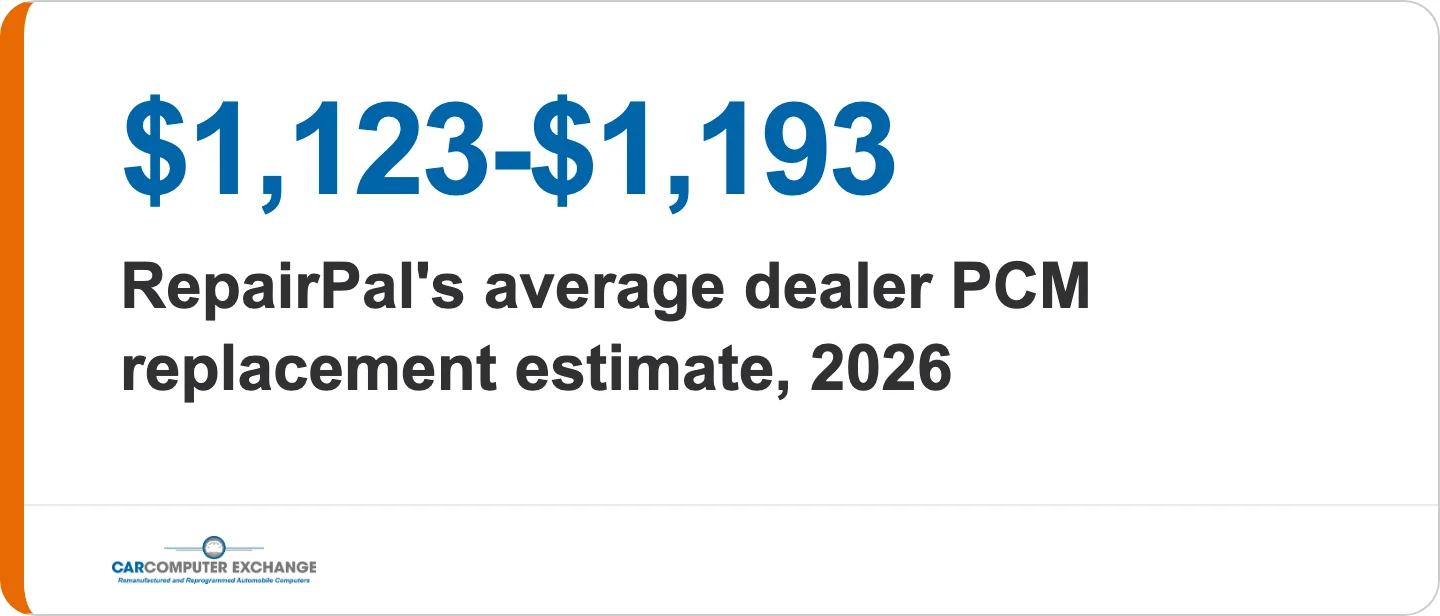
RepairPal’s average dealer PCM replacement estimate, 2026.
A remanufactured, pre-programmed module is the direct-to-you alternative, and most gas modules from Car Computer Exchange land in the $250 to $600 range for the same VIN-matched result. Spending an hour testing before you spend hundreds replacing is almost always worth it.
What to Do If Your ECM Is Actually Bad
Once testing confirms a failed module, a pre-programmed replacement gets you running without a dealer visit. Car Computer Exchange ships remanufactured ECMs, PCMs, and TCMs programmed to your exact VIN, mileage, and latest factory software, with keys and most anti-theft systems pre-synced. Most buyers plug the module in and drive.
Every module runs through a 13-point quality check on a computer-aided vehicle simulator before it ships. That rig emulates your car’s engine, transmission, emissions, and anti-theft systems and tests each circuit under load, which is a real test, not a bench power-on. Every order is backed by a free lifetime warranty with core return and a 60-day money-back guarantee, and Car Computer Exchange has served more than 150,000 customers since 2011.
To find your module, enter your year, make, and model on the Car Computer Exchange homepage, or browse modules by make for Ford, Dodge, and Jeep.
Frequently Asked Questions
Can you test an engine control module yourself?
Yes, up to a point. With an OBD-II scanner and a multimeter you can read codes, check power and grounds, test the 5-volt reference, and spot a no-communication module. Deeper internal electrical faults need specialized tools and are usually left to a shop or handled by replacing the module.
How can you tell if the ECM is bad and not just a sensor?
Look at what the codes point to and whether the module still communicates. A single sensor code usually means the sensor or its wiring, not the computer. A module with good power and grounds that still will not communicate, or that throws an internal fault code like P0606, points to the ECM itself.
Can I keep driving with a bad ECM?
It is not a good idea. A failing module can cause misfires, stalling, and poor fuel control that risk further engine damage, and it can leave you stranded if the car stops starting. Test it and address the fault instead of driving on it.
Do I need to reprogram a replacement ECM?
Yes. A replacement module must be programmed to your vehicle’s VIN and security data, or it will flag a code and often will not start the car. Modules from Car Computer Exchange ship pre-programmed to your VIN with keys and most anti-theft systems already synced, so no separate dealer programming trip is needed for most vehicles.
Can I repair my ECM myself?
Minor issues like cleaning a corroded connector or reseating a plug are do-it-yourself jobs. Internal failures of the processor or circuit board need specialized equipment and knowledge, so most drivers replace a confirmed-bad module rather than repair it at home.
The Bottom Line
Engine control module testing comes down to a simple rule: rule out the cheap causes before you condemn the computer. Read the codes, confirm power and grounds, check the 5-volt reference, and watch for a no-communication module. If those point to the ECM, and especially if an internal fault code like P0606 shows up, you have found your problem.
When testing confirms a failed module, Car Computer Exchange ships remanufactured ECMs, PCMs, and TCMs pre-programmed to your exact vehicle and tested on a 13-point vehicle simulator, so the replacement arrives ready to install. Enter your year, make, and model to find the right module for your vehicle.
Sources