ECU Programming in 2026: How It Works and When You Need It
ECU programming is the process of writing or updating the software on a vehicle’s electronic control unit to change how the engine and related systems run. It follows three steps: read the original file off the module, modify or replace the settings, and write the new file back. Drivers reach for it in two very different situations, and telling them apart matters: tuning an engine for more performance, or getting a replaced or repaired control module to work with the car.
Car Computer Exchange has served more than 150,000 customers, and our remanufactured modules ship pre-programmed to the VIN, so much of this guide covers a step many owners can skip entirely.
Key Takeaways
- ECU programming means rewriting the software on your car’s computer. The core process is always read, modify, write, whether the goal is a performance tune or a working replacement module.
- The two reasons to program an ECU are not the same. Performance tuning changes the factory calibration. Replacement programming just gets a new or repaired module talking to the car.
- A replaced ECM or PCM will not run the engine until it is programmed with your VIN. On vehicles with an immobilizer, the anti-theft system also has to accept the new module, so a blank or unprogrammed unit keeps the car from starting.
- DIY programming is possible but risky. It needs a J2534 pass-through device, a laptop with the right software, the correct file, and a stable power supply to avoid bricking the module.
- A module that ships pre-programmed to your VIN skips the programming step. No J2534 tool and no dealer visit are needed for most installs.
What Is ECU Programming?
An ECU, or electronic control unit, is the computer that runs your engine. It reads sensors for air, fuel, temperature, and position, then controls fuel delivery, spark timing, idle, emissions, and the transmission based on software stored inside it. ECU programming is the act of changing that software.
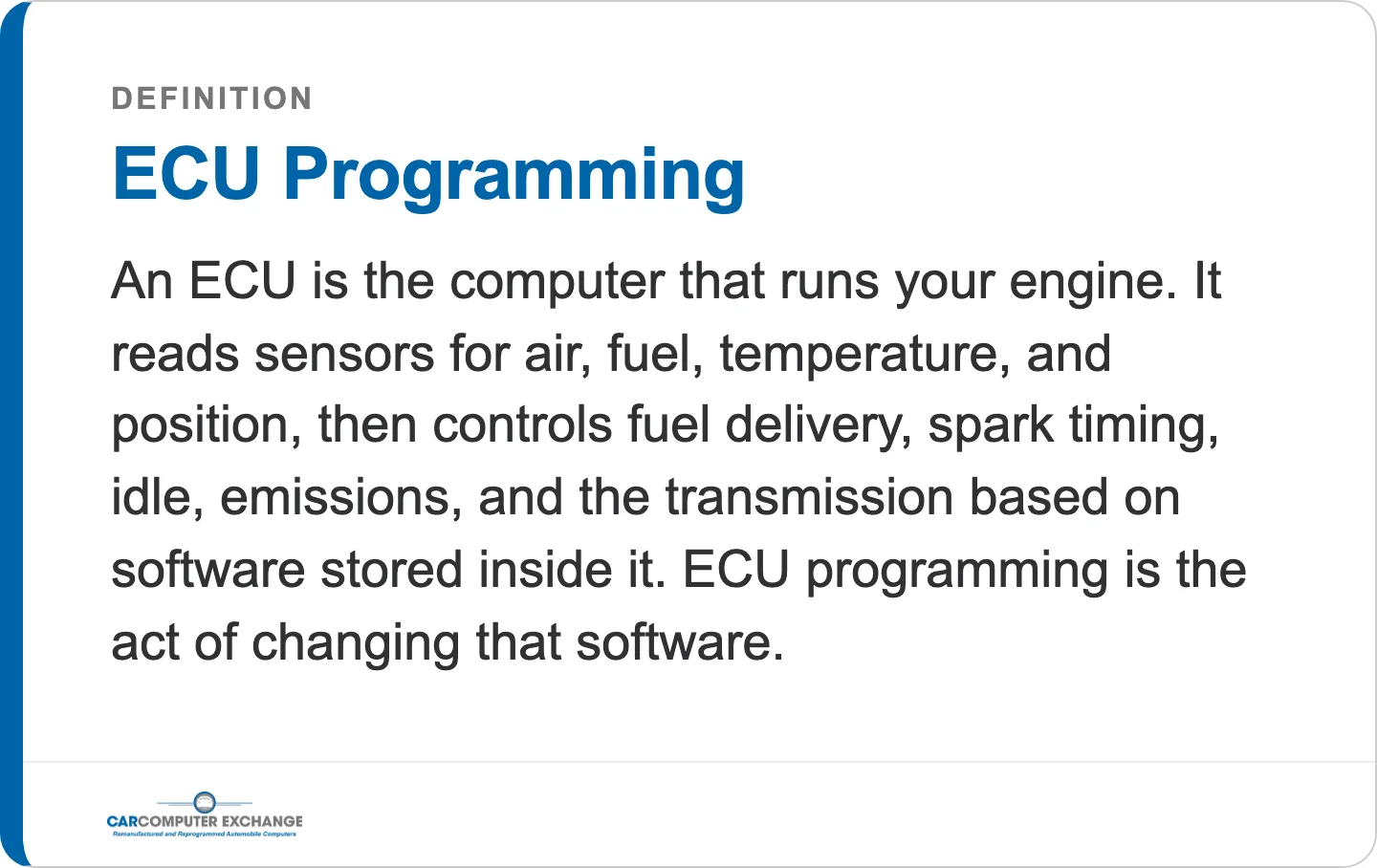
What ECU programming actually changes on your vehicle’s computer.
The terms overlap in everyday use. An ECU (engine or electronic control unit), an ECM (engine control module), and a PCM (powertrain control module, which also manages the transmission) are all the vehicle’s control computer. Programming them works the same way regardless of the label. For a fuller breakdown of what these modules do, see our guide to how car computers work.
How ECU Programming Works: Read, Modify, Write
Every ECU programming job follows the same three steps, no matter the tool or the goal.
- Read. A programming device connects to the module and pulls the original software file, called the calibration or ROM, out of its memory.
- Modify. The file is edited or swapped. A tuner changes fuel, air, and spark tables. A replacement job loads the correct factory calibration for that exact vehicle.
- Write. The device flashes the new file back into the module’s permanent memory, and the module now runs the updated software.
The connection between the laptop and the vehicle usually runs through a J2534 pass-through interface. The J2534 standard, defined by SAE International, specifies how a PC reprograms a vehicle’s control modules through the OBD-II port, so one interface can flash many makes.
ECU Programming vs. ECU Coding
ECU programming and ECU coding are related but different jobs, and the words get mixed up often.
- Programming (or flashing) writes a full software or calibration file into the module. This is what you do to update firmware, load a tune, or set up a replacement module.
- Coding adjusts settings and parameters the existing software already supports, such as enabling a feature or matching a module to other components. It changes how the current software behaves without replacing the file.
For most engine replacement and repair work, programming is the step that matters. Coding shows up more in body, comfort, and feature modules.
How the ECU Connects: OBD-II, Bench, and Boot Modes
There are three ways a programming tool connects to an ECU, and which one a job needs depends on the vehicle and the module.
- OBD-II (in-car): The tool plugs into the OBD-II port under the dash, and the module stays in the car. This is the most common method and the only one a typical DIYer can attempt.
- Bench mode: The module is removed from the vehicle and wired directly to the tool on a bench. It is used when the software cannot be reached through the port, or when the module will not boot in the car.
- Boot mode: The module’s case is opened and the tool connects to pins on the circuit board. It is the last resort, used for locked or dead modules, and it carries the most risk.
What You Need to Program an ECU
Programming an ECU yourself takes four things, and missing any one of them can leave you with a dead module.
- Hardware: A J2534 pass-through device or a module-specific programmer that connects the laptop to the vehicle.
- Software: A laptop running the correct factory (OEM) or tuning software for that make, plus a subscription in many cases.
- The correct file: The exact factory calibration for your year, make, model, and engine, or a tune built for it.
- Stable power: A battery maintainer to hold voltage steady during the flash. A voltage drop mid-write can corrupt the software and brick the module.
This is why many owners send the work out. A failed flash can turn a working computer into scrap, and recovery often means bench or boot-mode intervention.
When Do You Need ECU Programming?
ECU programming is needed in two situations, and they call for different work. The first is performance tuning, where a driver changes the factory calibration to raise power, adjust throttle response, or support engine modifications. The second, and the more common reason at a repair shop, is replacing or repairing a failed module.
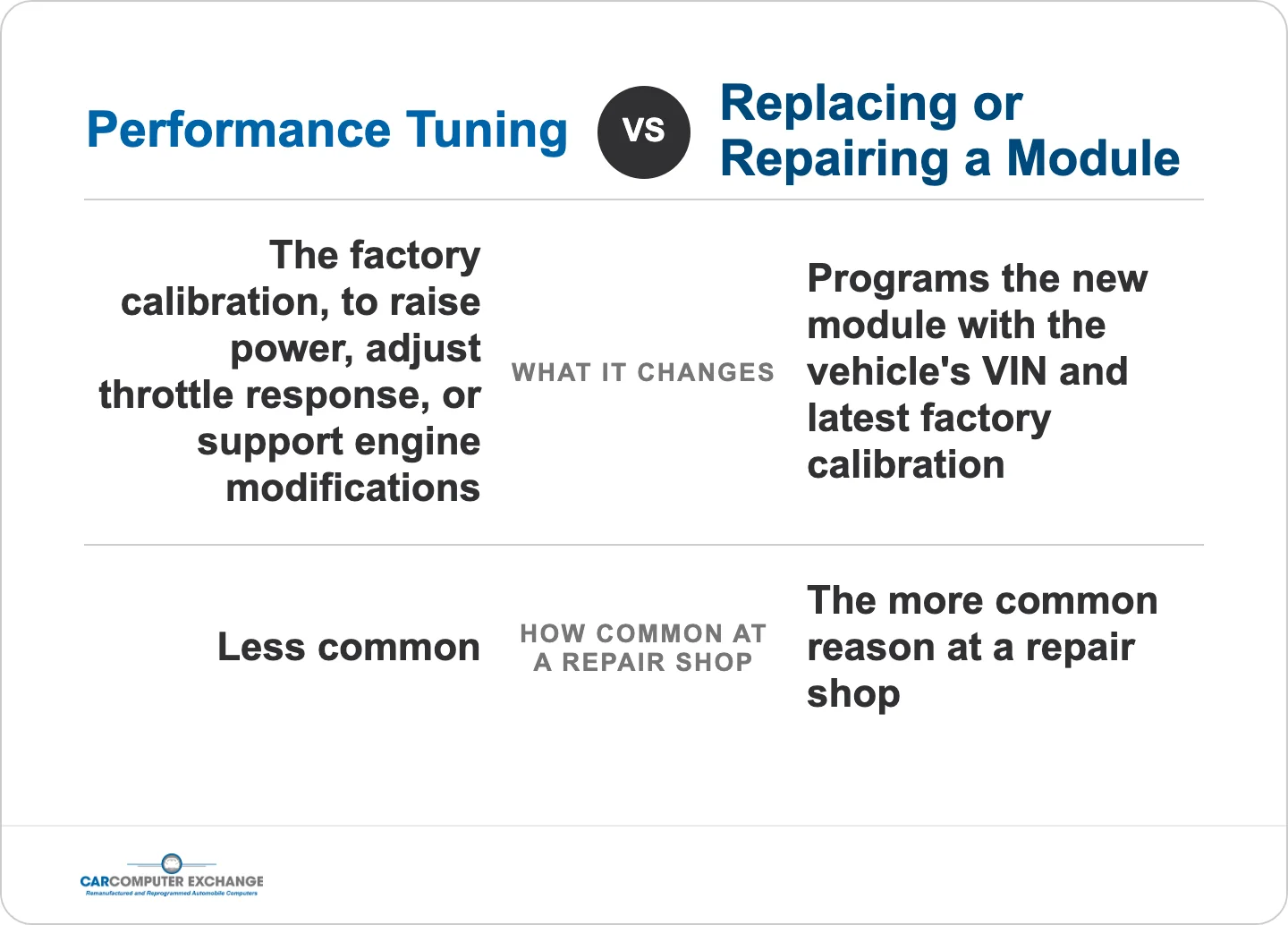
Two very different jobs share the same word: programming an ECU.
When an ECM or PCM is swapped, the new module does not automatically know the car. It has to be programmed with the vehicle’s VIN and loaded with the latest factory calibration before the engine will start. A published manufacturer technical service bulletin on control-module replacement documents this step: the VIN has to be written to the new ECM or PCM during replacement. On vehicles with an immobilizer, the anti-theft system also has to accept the new module before it will start and run.
If you are replacing a failed unit, our guides on replacing a car ECM and ECM reflashing and remapping walk through the process in more detail.
Do You Need a Dealer to Program a Replacement Module?
Whether you need a dealer depends entirely on how the replacement module arrives. A blank, salvage, or generic module has no calibration and no VIN, so it needs a dealer, a locksmith, or an independent shop with a J2534 setup to program it before the car will run. That programming step is often a separate charge on top of the part.
A module that ships pre-programmed to your VIN is different. The calibration and VIN are already loaded, and most anti-theft systems are pre-synced, so it installs and runs without a programming appointment on most vehicles. The physical swap on most vehicles is often under an hour with hand tools. The programming, not the wrench, is the part that usually sends people to a dealer.
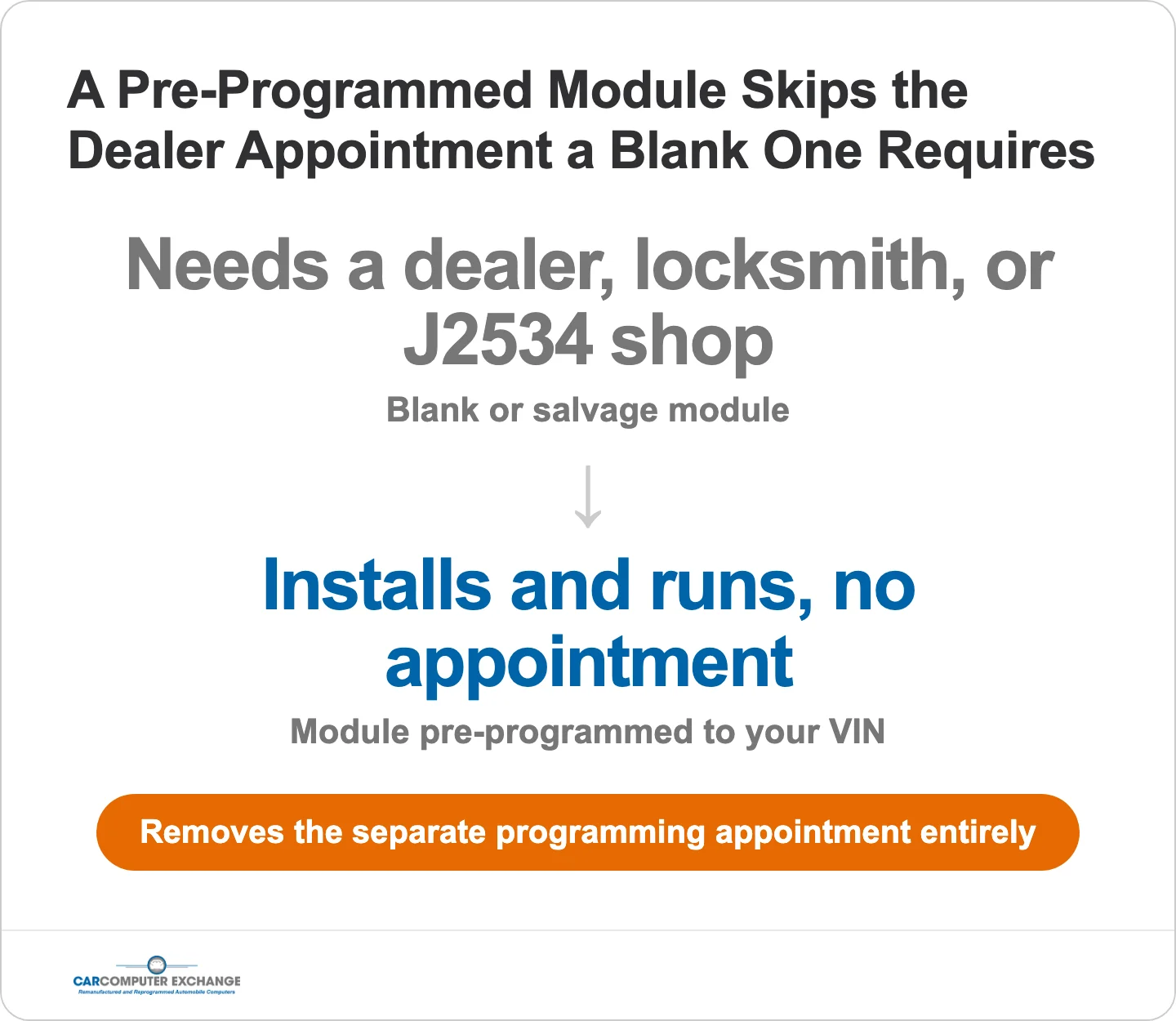
Whether you need a dealer comes down to how the replacement module arrives.
How Much Does ECU Programming Cost?
ECU programming cost depends on whether you are paying for programming alone or a full module replacement. As of 2026, RepairPal estimates a typical dealer powertrain control module (PCM) replacement at $1,123 to $1,193, and dealer pricing runs higher on many vehicles once diagnosis and programming are added. A large share of that cost is the programming step, which a dealer or independent shop bills on top of the part.
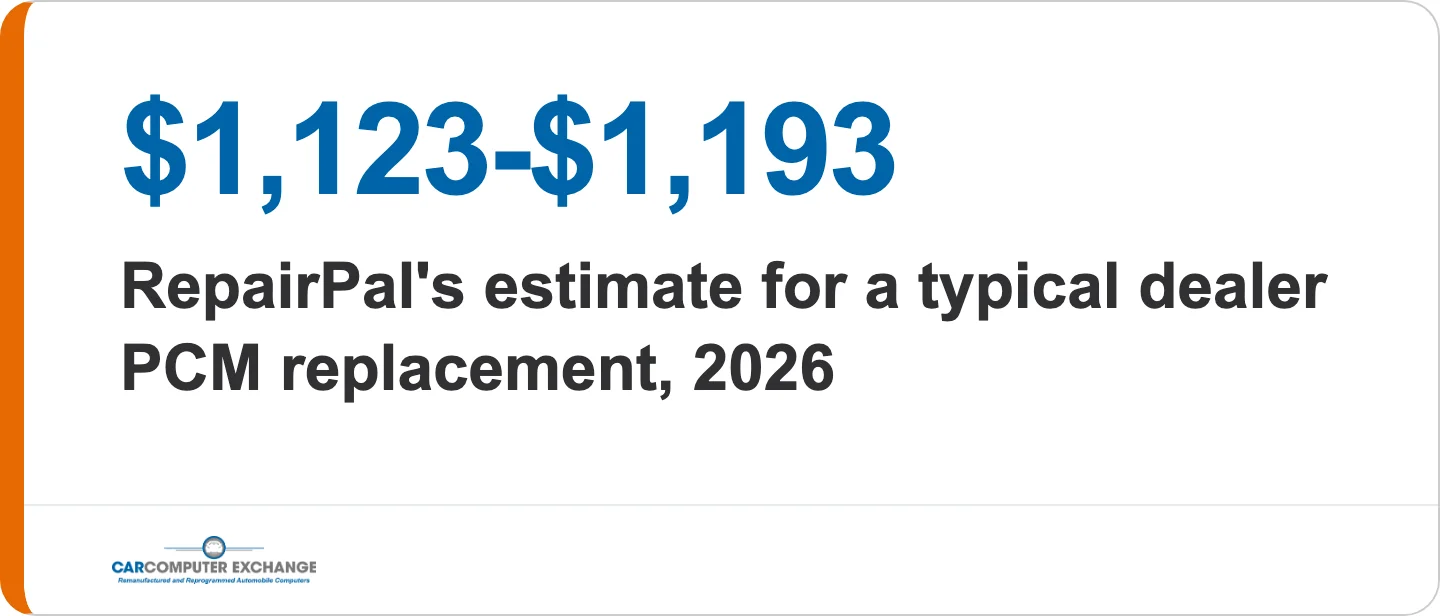
RepairPal’s 2026 estimate for a typical dealer PCM replacement.
A VIN-programmed replacement module folds the programming into the part, so there is no separate flash fee and no dealer appointment for most installs. For a closer look at the numbers, see our breakdown of ECU repair costs.
Is ECU Programming Legal?
ECU programming is legal when it keeps the vehicle at its factory emissions calibration, and illegal when it defeats an emissions control. Under Section 203 of the Clean Air Act (42 U.S.C. 7522), it is against federal law to tamper with or disable a vehicle’s emissions controls, or to make or sell a device that does so.
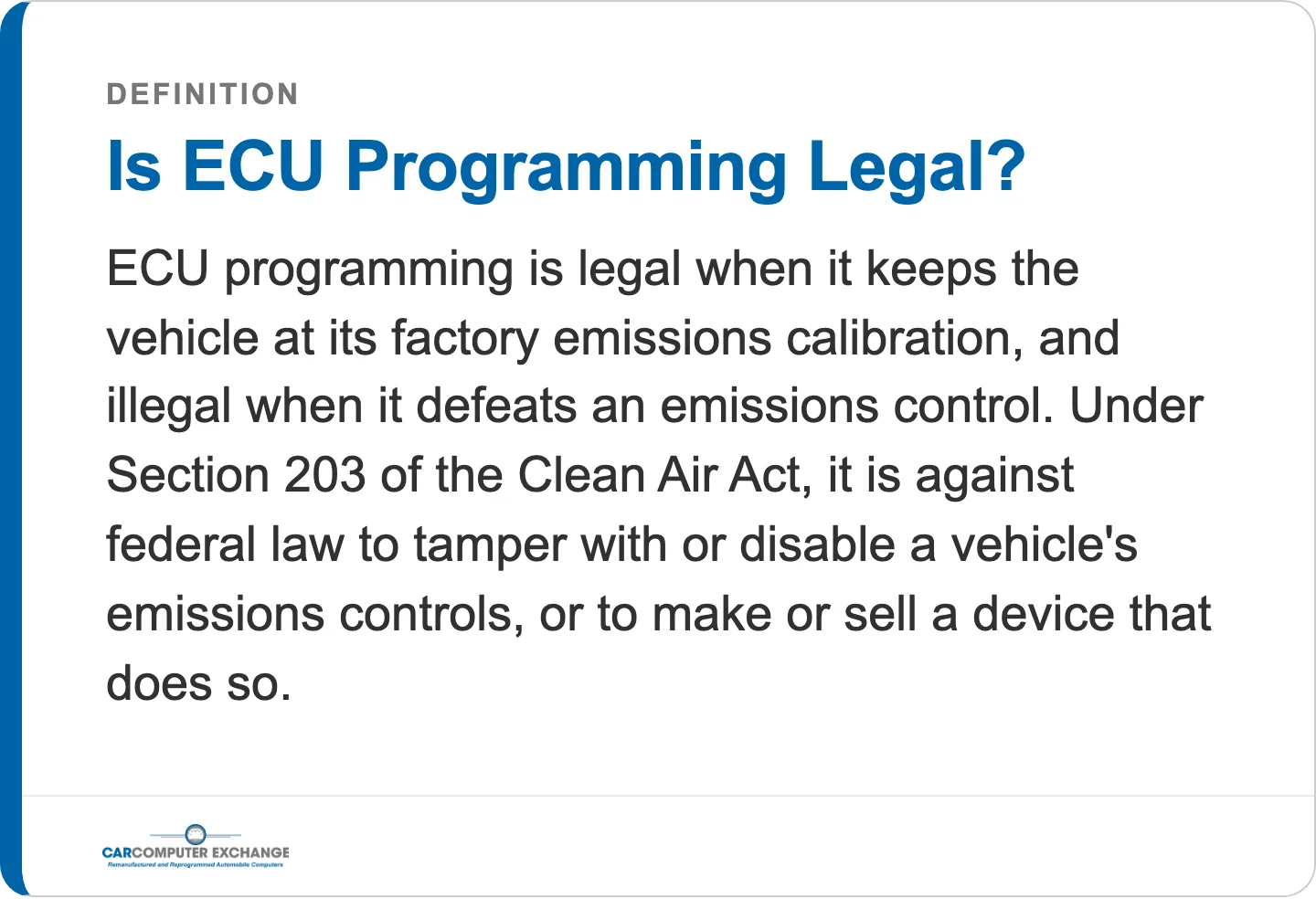
The legal line is whether the programming defeats an emissions control, not whether the software changed at all.
The EPA actively enforces this against aftermarket “defeat device” tunes that switch off emissions equipment for more power. Updating a module to the latest factory calibration, or installing a VIN-matched replacement that keeps the emissions systems intact, is standard repair work and is not the same as tampering. The line is whether the programming defeats an emissions control, not whether the software was changed at all.
A Pre-Programmed Module Skips the Programming Step
If you are replacing a failed ECM, PCM, or TCM, the simplest path is a module that arrives already programmed. Car Computer Exchange ships remanufactured modules pre-programmed to your exact VIN, mileage, and the latest factory software, with keys and most anti-theft systems pre-synced. For most vehicles you plug it in and drive, with no J2534 tool, no tuning software, and no dealer programming fee.
Every module runs through a 13-point quality check on a computer-aided vehicle simulator that emulates the car’s engine, transmission, emissions, and anti-theft systems under load before it ships. Every module is backed by a free lifetime warranty when you send your old core back, and a 60-day money-back guarantee if it does not solve the problem.
We cover domestic gas platforms (Chrysler, Dodge, Ford, Jeep, Lincoln, Mercury, and Plymouth), Honda, Toyota, and Lexus, and diesel platforms including Cummins, Ford Power Stroke, Detroit Diesel, Caterpillar, International, and Mack. Those modules ship ready to install. Mercedes modules and Dodge, Chrysler, Jeep, Ram, and Volkswagen TIPMs use a send-in repair process instead: you ship us the module, we rebuild and reprogram it, and send it back.
To find the right module, enter your year, make, and model on the Car Computer Exchange homepage, or browse modules by make for Ford and Dodge. You can read 4,500+ customer reviews and our full warranty terms before you order.
Frequently Asked Questions
Can you program an ECU yourself?
You can program an ECU yourself, but it takes the right setup and carries real risk. You need a J2534 pass-through device, a laptop with the correct factory or tuning software, the exact calibration file for your vehicle, and a battery maintainer to hold voltage steady during the flash. A power drop or wrong file mid-write can brick the module. Many owners avoid the risk by buying a module that ships pre-programmed to their VIN.
How much does it cost to reprogram an ECU?
A typical dealer powertrain control module replacement runs about $1,123 to $1,193 as of 2026, based on independent repair-cost estimates, and higher on many vehicles once diagnosis and dealer programming are added. A replacement module that arrives pre-programmed to your VIN folds the programming in, so there is no separate fee.
Is ECU tuning illegal?
Performance ECU tuning is illegal when it disables or defeats a vehicle’s emissions controls, which the EPA enforces under the Clean Air Act. Programming that keeps the vehicle at its factory emissions calibration, such as a software update or a VIN-matched replacement module, is legal standard repair work.
Do I need a dealer to program a new ECM or PCM?
You need a dealer or an independent shop with a J2534 setup only if the replacement module arrives blank or unprogrammed. A module that ships pre-programmed to your VIN, with most anti-theft systems already synced, installs and runs without a dealer appointment on most vehicles.
What is the difference between ECU programming and coding?
ECU programming, or flashing, writes a full software or calibration file into the module, which is what a firmware update, a tune, or a replacement module needs. ECU coding adjusts settings the existing software already supports, such as enabling a feature or pairing a module to other components, without replacing the file.
The Bottom Line
ECU programming comes down to reading the module’s software, changing it, and writing it back. For a performance tune that means a new calibration, and the emissions rules matter. For a failed engine computer it means getting a replacement module matched to your VIN and immobilizer so the car will start. The programming step is the part that usually sends drivers to a dealer, not the physical install.
That is the step Car Computer Exchange removes. Our remanufactured PCMs, ECMs, and TCMs ship pre-programmed to your VIN and tested on a full vehicle simulator, so most drivers replace a failed module without a J2534 tool or a dealer visit. If a scan tool has pointed at your engine computer, enter your year, make, and model to find the right module for your vehicle.
Sources
- SAE International: J2534 Pass-Thru Vehicle Programming Standard
- NHTSA: Technical Service Bulletin on Control Module Programming
- U.S. Government Publishing Office: 42 U.S.C. 7522, Clean Air Act Prohibited Acts
- U.S. EPA: Stopping Aftermarket Defeat Devices Enforcement Initiative
- RepairPal: Powertrain Control Module Replacement Cost Estimate