What Is an Engine Control Module (ECM)? Full Guide (2026)
An engine control module (ECM) is the computer that runs your engine. It takes readings from a network of sensors, works out how the engine should behave from one moment to the next, and signals components such as the fuel injectors and ignition coils to respond. Many carmakers and technicians call this same part the engine control unit (ECU), so the two terms usually point to the exact same box.
Drivers most often hear “ECM” when a warning light, a stalling engine, or a repair quote points at the engine computer. This guide explains what an engine control module is, what it controls, how it works, and how it differs from a PCM or a TCM.
Key Takeaways
- An engine control module (ECM) is your engine’s dedicated computer. It turns live sensor readings into fuel, spark, and idle commands while the engine runs.
- ECM and ECU are two names for the same part. Some brands say engine control module, others say engine control unit.
- The ECM manages fuel, spark, air, idle, and emissions. It is the single part behind many different engine functions.
- An ECM is not a PCM or a TCM. A PCM runs the engine and transmission together, while a TCM runs the transmission alone.
- A trouble code points at a system, not always at a dead ECM. Sensors, wiring, and bad grounds cause the same symptoms, so the module is rarely the first thing to replace.
What Is an Engine Control Module?
An engine control module (ECM) is a small computer that manages how a vehicle’s engine runs. It sits at the center of the engine’s electronics, taking in sensor data and adjusting fuel, spark, and air so the engine starts, idles, and drives correctly. Wikipedia describes the part plainly: an engine control unit is “a device that controls various subsystems of an internal combustion engine”, including the fuel injection and ignition systems.
The same part carries two common names. As the fleet-technology reference Lytx notes, the terms “are often used interchangeably, as many manufacturers use them” for the same thing. Whether your paperwork says ECM or ECU, it is describing the engine’s computer.
The engine computer is only one of many modules in a modern vehicle. Some complex cars run as many as 150 electronic control units, according to Total Phase, handling everything from the brakes to the door locks. The ECM is the one dedicated to the engine.
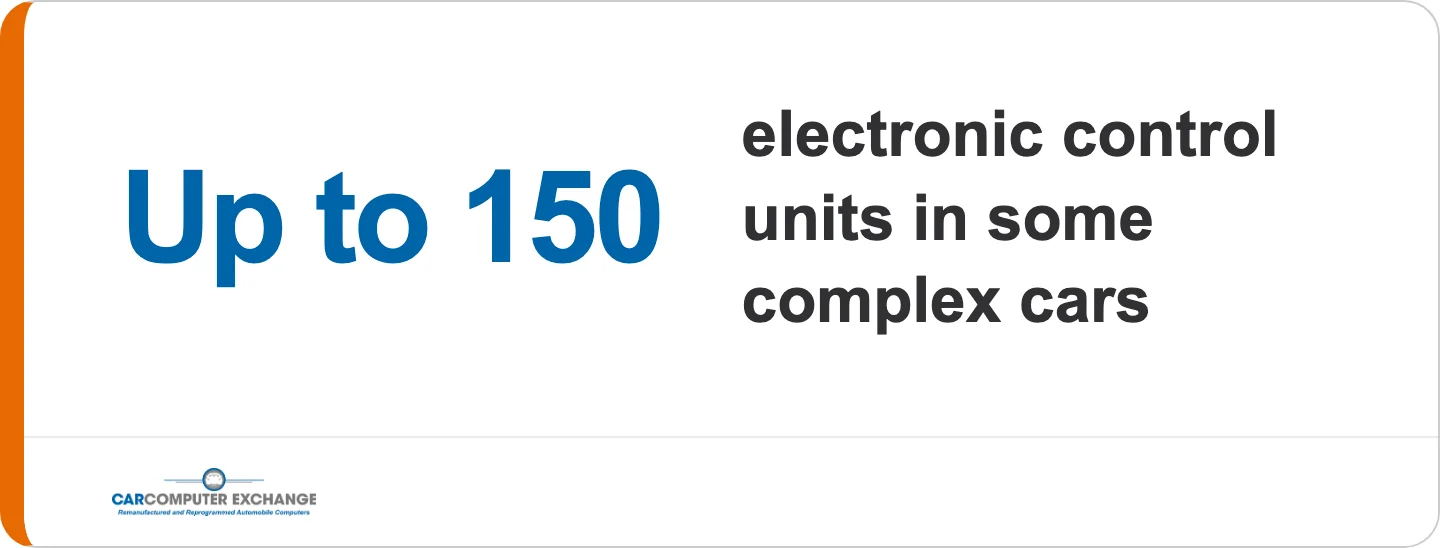
Some complex cars run as many as 150 electronic control units, and the engine control module is the one dedicated to the engine. Source: Total Phase.
What Does an Engine Control Module Do?
The engine control module controls the parts that decide how the engine runs every second the key is on. According to the vehicle-data company Geotab, the ECM manages the fuel injectors, ignition system, air intake, emissions components, and the cooling system.
- Fuel delivery. The ECM decides when each injector opens and how long it stays open, so the fuel mixture matches a cold start, a warm idle, or a heavy load.
- Ignition timing. On gas engines it fires the spark plugs at the right instant to burn the fuel cleanly.
- Air intake. It manages how much air enters the engine to pair with the fuel.
- Idle speed. It holds the engine at a steady speed when the vehicle is stopped.
- Emissions monitoring. It watches exhaust readings, stores fault codes, and turns on the check engine light when something drifts out of range.
- Cooling fans. On many vehicles it commands the fans and works with the thermostat to control engine temperature.
Each ECM control area maps to something a driver can actually feel when control is lost.
| ECM control area | What it manages | What a driver may notice |
|---|---|---|
| Fuel control | Injector timing and fuel mixture | Hard starts, misfires, poor fuel economy |
| Ignition control | Spark timing on gas engines | Rough running, stalling, low power |
| Air and idle control | Airflow and engine speed at rest | Surging, low idle, start-and-die problems |
| Emissions monitoring | Fault tracking and the check engine light | Repeat codes, failed inspection readiness |
| Module communication | Data shared with other computers | No communication, limp mode, mixed codes |
How Does an Engine Control Module Work?
An engine control module works as a fast, repeating loop that runs many times per second while the engine is on. It measures what the engine is doing, checks that against its factory calibration, and adjusts the engine to match.
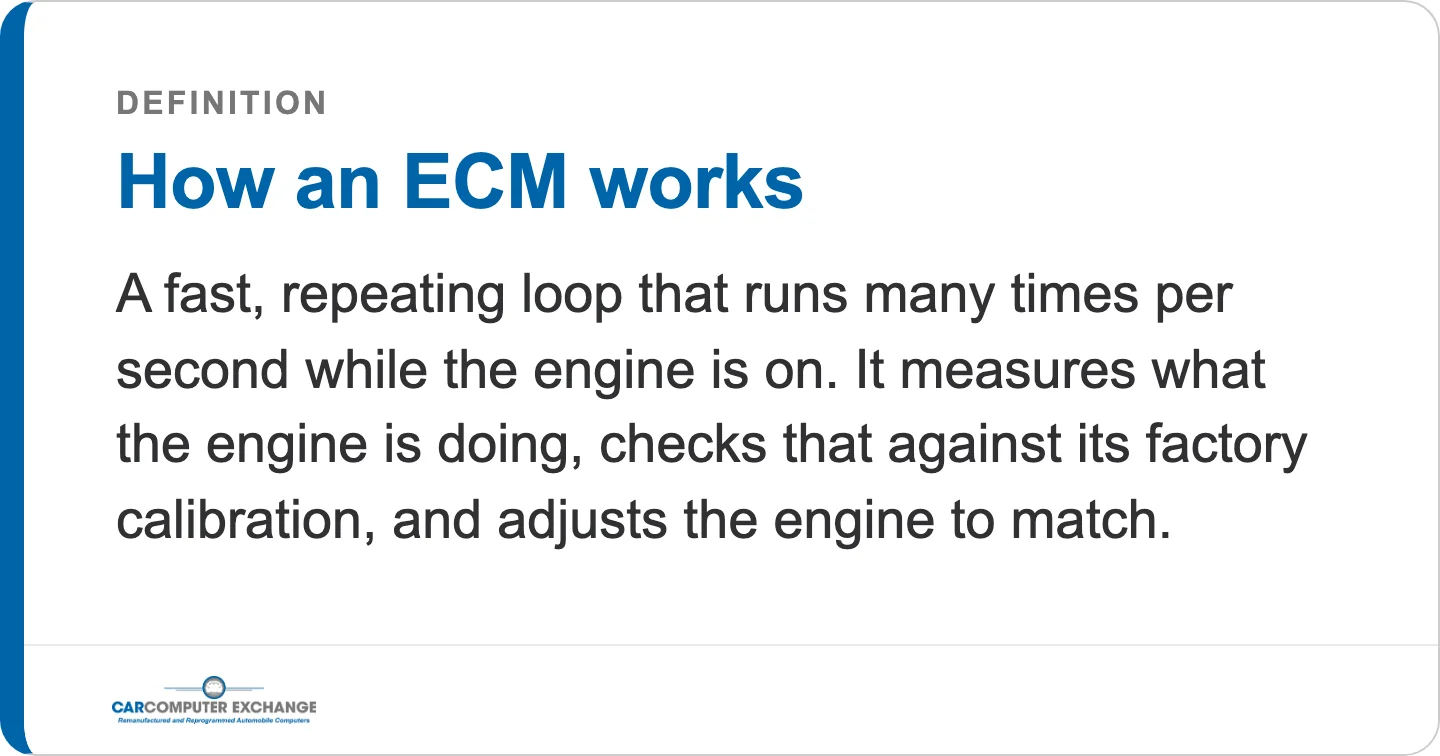
The ECM runs a fast loop many times per second: it measures what the engine is doing, checks it against its factory calibration, and adjusts the engine to match.
- It reads the inputs. Signals come from parts like the oxygen sensor, mass airflow sensor, throttle position sensor, and coolant temperature sensor.
- It checks them against its calibration. It compares those readings to the factory settings to pick the right fuel, spark, and idle for that instant.
- It drives the actuators. It signals the injectors, ignition coils, and other parts to carry out the decision.
The ECM also keeps a record when something goes wrong. Geotab notes that the module performs diagnostic functions, including generating diagnostic trouble codes (DTC) and data logging. Those stored car computer trouble codes are what a scan tool reads, and they are why the check engine light comes on when the ECM sees a problem.
ECM vs ECU vs PCM vs TCM
The engine computer goes by several names, and they are not all interchangeable. Getting the term right matters because it decides which module actually fits your vehicle.
- ECM and ECU describe the same engine-only computer. One is engine control module, the other is engine control unit.
- PCM (powertrain control module) runs the engine and the transmission from one unit. Wikipedia describes a PCM as a “combined controller consisting of the engine control unit (ECU) and the transmission control unit (TCU).” Many modern vehicles use a single PCM instead of a separate ECM.
- TCM (transmission control module) runs the transmission alone, handling gear selection and shift timing.
So does the ECM control the transmission? On its own, no. A pure ECM manages the engine, while a separate TCM manages the transmission. When one module does both jobs, that module is a PCM. If your repair paperwork says PCM, searching for a part labeled ECM by name alone can point you to the wrong module. Our guide on ECU vs ECM breaks the naming down further.
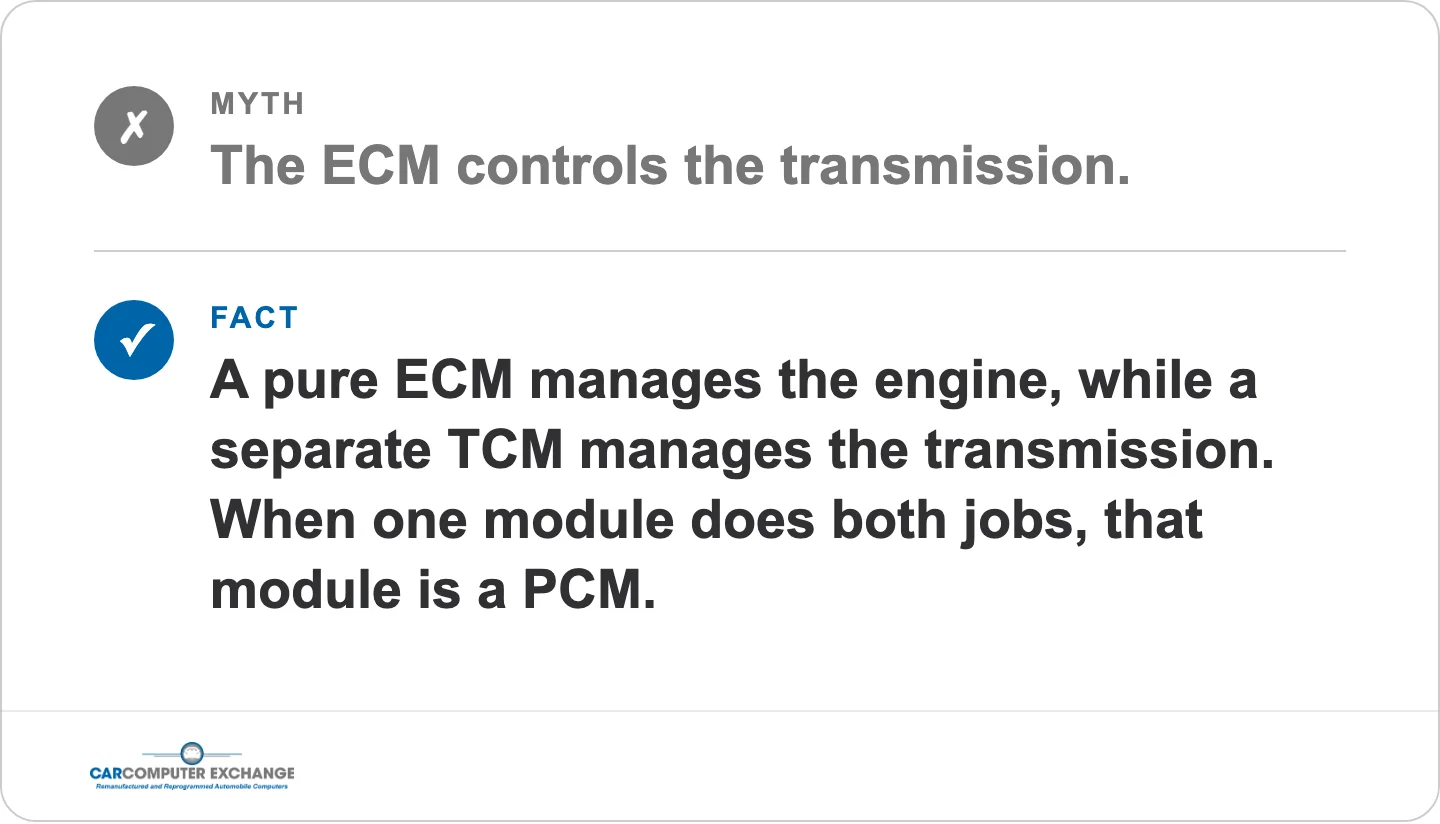
A pure ECM runs the engine only. When one module runs both the engine and the transmission, it is a PCM.
Signs of a Failing Engine Control Module
The most common signs of a failing engine control module are a check engine light that will not clear, stalling or misfires, a no-start condition, and a drop in fuel economy. Geotab lists the common symptoms of a faulty ECM as a misfiring engine, lower fuel efficiency, stalling or rough idling, sluggish acceleration, trouble shifting gears, and a failure to communicate with the module through an OBD scanner. Because the ECM touches so many systems, a failure often shows up as several odd problems at once.
- Check engine light that keeps returning. A failing module can set false sensor codes even after parts are replaced.
- Stalling or misfires. The engine can lose spark or fuel control and run rough or shut off.
- No-start with the engine cranking. The starter turns the engine over, but the computer never commands fuel or spark.
- Poor fuel economy. A wrong air-fuel mix makes the engine burn more gas than normal.
- Limp mode. The vehicle drops into reduced power to protect itself and get you to a shop.
A trouble code is a clue, not proof the module is dead. Sensors, wiring, blown fuses, and bad grounds cause the same symptoms, so those should be ruled out first. Our overview of bad ECM symptoms covers what to check, and a scan tool that shows no communication with the ECM points more directly at the computer or its power and ground circuits.
Sensors, wiring, blown fuses, and bad grounds cause the same symptoms as a failing ECM, so rule them out first.
Where Is the Engine Control Module Located?
The engine control module’s location varies from one vehicle to the next. It is commonly mounted in the engine bay near the firewall or the battery, or inside the cabin under the dashboard or a kick panel. It usually looks like a sealed metal or plastic box with one or more large wiring connectors.
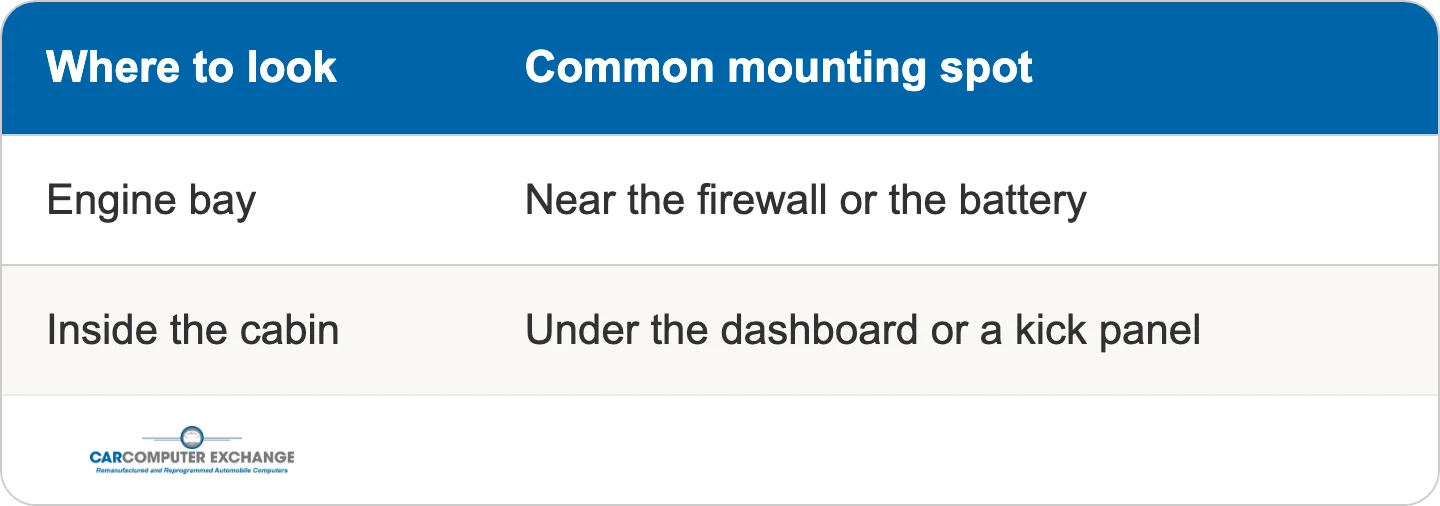
The ECM is commonly mounted in the engine bay or inside the cabin. Your owner’s manual or the part number on the module confirms the exact spot.
Your owner’s manual or the part number stamped on the module confirms the exact spot for your vehicle. For a closer look at common mounting points, see our guide on where the ECM is located.
Why Is an ECM Programmed to Your Vehicle?
An engine control module is programmed so its software matches one specific vehicle. That programming ties the module to the VIN, the engine size, the emissions package, and the security system. Each module is calibrated for one exact application, which is why the same hardware behaves differently from one car to the next.
This is why an engine computer pulled from another vehicle rarely works on its own. Without the correct calibration, a module may crank the engine but not start it, fail to communicate with other systems, or set new codes. The programming is what makes the hardware behave like your engine’s original computer.
What Can Damage an Engine Control Module?
Engine control modules are built to last, but a few conditions shorten their life. Knowing them helps explain why a module fails and what to fix alongside it.
- Heat and vibration. Constant engine heat and vibration can weaken solder joints and internal parts over time.
- Water and corrosion. Moisture in a connector can corrode pins and circuits. Fix the leak before fitting another module, or the new one faces the same problem.
- Voltage problems. Weak battery connections, charging faults, and jump-start mistakes can send bad voltage through sensitive electronics.
Frequently Asked Questions
What is an ECM in a car?
An ECM in a car is the engine control module, the computer that manages engine functions such as fuel delivery, ignition timing, idle speed, and emissions monitoring. Many manufacturers call the same part the engine control unit, or ECU.
What does an ECM control?
An ECM controls fuel delivery, ignition timing, air intake, idle speed, emissions monitoring, cooling fan operation, and the data shared with other vehicle computers. It reads sensors and adjusts these functions in real time.
Is an ECM the same as an ECU?
For everyday purposes, yes. ECM stands for engine control module and ECU for engine control unit, and carmakers use the two labels for the same engine computer. The part number and vehicle details are what actually decide which module fits.
Does the ECM control the transmission?
No, an engine control module controls the engine, not the transmission. A vehicle that runs both from one unit is using a powertrain control module (PCM), while a separate transmission control module (TCM) handles the transmission on its own.
What are the signs of a bad ECM?
Common signs of a bad ECM include a check engine light that will not clear, stalling, misfires, a no-start with the engine cranking, poor fuel economy, and limp mode. Sensors and wiring cause the same symptoms, so the diagnosis should be confirmed before replacing the module.
Can you drive with a bad ECM?
You can sometimes drive with a failing ECM, but it is risky. The engine may stall, lose power, or drop into limp mode without warning, so the safer choice is to have the module and its circuits checked.
Why does an ECM need programming?
An ECM needs programming so its software matches your vehicle’s VIN, engine, emissions, and security setup. Without that calibration, a module built for a different vehicle may not start the engine or communicate with the other computers.
Conclusion
An engine control module is your engine’s own computer, and the same part often appears as an ECU depending on the brand. It manages fuel, spark, air, idle, and emissions by reading sensors and adjusting the engine in real time, and it is separate from the PCM that also runs the transmission and the TCM that runs the transmission alone. Knowing which module your vehicle uses, and remembering that a trouble code is a starting point rather than a verdict, makes any repair conversation easier to follow.
Car Computer Exchange has specialized in remanufactured, VIN-programmed engine control modules for domestic and diesel vehicles since 2011, with more than 150,000 customers served. To see how the engine computer fits with the rest of a car’s electronics, read our guide on how the engine control unit works.
Sources