Where Is the PCM Located? ECM Location Guide (2026)
Most PCMs are located in the engine bay, usually near the battery, the firewall, or the inner fender. Some vehicles mount the module inside the cabin instead, behind a kick panel or under the dashboard. The exact spot depends on your make, model, and year, so the surest way to find it is to match your vehicle to its typical location and then trace the wiring harness to the module.
The powertrain control module (PCM) and the engine control module (ECM) are the same physical box on most modern vehicles. Wherever it sits, it looks like a flat metal case with one or more large plastic wiring plugs bolted into it.
Key Takeaways
- Two common locations. The PCM or ECM is either in the engine compartment (near the battery, firewall, or fender) or inside the cabin (behind a kick panel or under the dash).
- Location changes by platform. Most Ford, Dodge, Jeep, and Chrysler vehicles keep it under the hood. Many Honda and Toyota models put it inside the cabin on the passenger side.
- Diesel is a special case. The 5.9L Cummins ECM bolts to the engine block, while the 6.7L Cummins (2013 and later) moved it inside the cab behind the passenger kick panel.
- Trace the wires to find it. Follow the thick main wiring harness and it leads you to a flat, finned metal box with large connectors.
- A replacement must be programmed to your VIN. An unprogrammed module triggers anti-theft lockout and will not start the engine.
Where Is the Engine Computer Located? The Two Common Spots
The engine computer sits in one of two places on almost every vehicle, and knowing which one saves you from searching blind. The location varies by make and model, so the position moves from car to car, but it almost always falls into one of these two buckets:
- Engine compartment. Mounted on the firewall, next to the fuse box, or tucked against the inner fender near the battery. This is the most common spot for domestic trucks and cars.
- Vehicle interior. Placed behind the driver or passenger side kick panel, under the dashboard, or near the floorboard by the passenger’s feet. Many import cars and some newer platforms use this location for better heat protection.
If your owner’s manual lists the module location, start there. If it does not, match your make to its typical position, then confirm the exact spot by tracing the wiring harness to the module.
PCM and ECM Location by Make and Model
The positions below are the typical location for each platform. Confirm the exact spot against your vehicle’s service manual, since it can shift by year, engine, and trim.
| Make | Typical PCM / ECM location |
|---|---|
| Ford (Focus, Taurus, Explorer, F-Series, Flex) | Engine bay, on or near the firewall, often the driver’s side |
| Dodge and Chrysler (gas) | Engine bay, passenger side near the firewall or inner fender, close to the battery |
| Jeep (Wrangler, Cherokee, Commander) | Engine bay, right side near the firewall or inner fender |
| Honda (Accord, Civic) | Inside the cabin, under the passenger-side floor or behind the kick panel |
| Toyota (Camry, Corolla) | Inside the cabin, behind the glove box or under the passenger-side dash |
Two patterns hold across the list. Domestic trucks and cars usually keep the module under the hood, while many import sedans move it inside the cabin. When in doubt, tracing the main wiring harness to the module works on any vehicle regardless of make.
Cummins Diesel ECM Location (Ram 2500/3500)
Diesel Ram trucks use a separate ECM from the gas models, and its location changed significantly between generations. On the 5.9L Cummins (1998 to 2007), the ECM bolts directly to the engine block on the driver’s side, near the injection pump, where it is exposed to engine heat and road splash. A separate transmission controller sits on the passenger-side top of the firewall.
On the 6.7L Cummins (2013 and later), the ECM moved inside the cab for protection. It sits behind the passenger-side kick panel, the plastic trim panel in the passenger footwell. To match the exact module to your truck, browse Cummins diesel modules by year and engine.
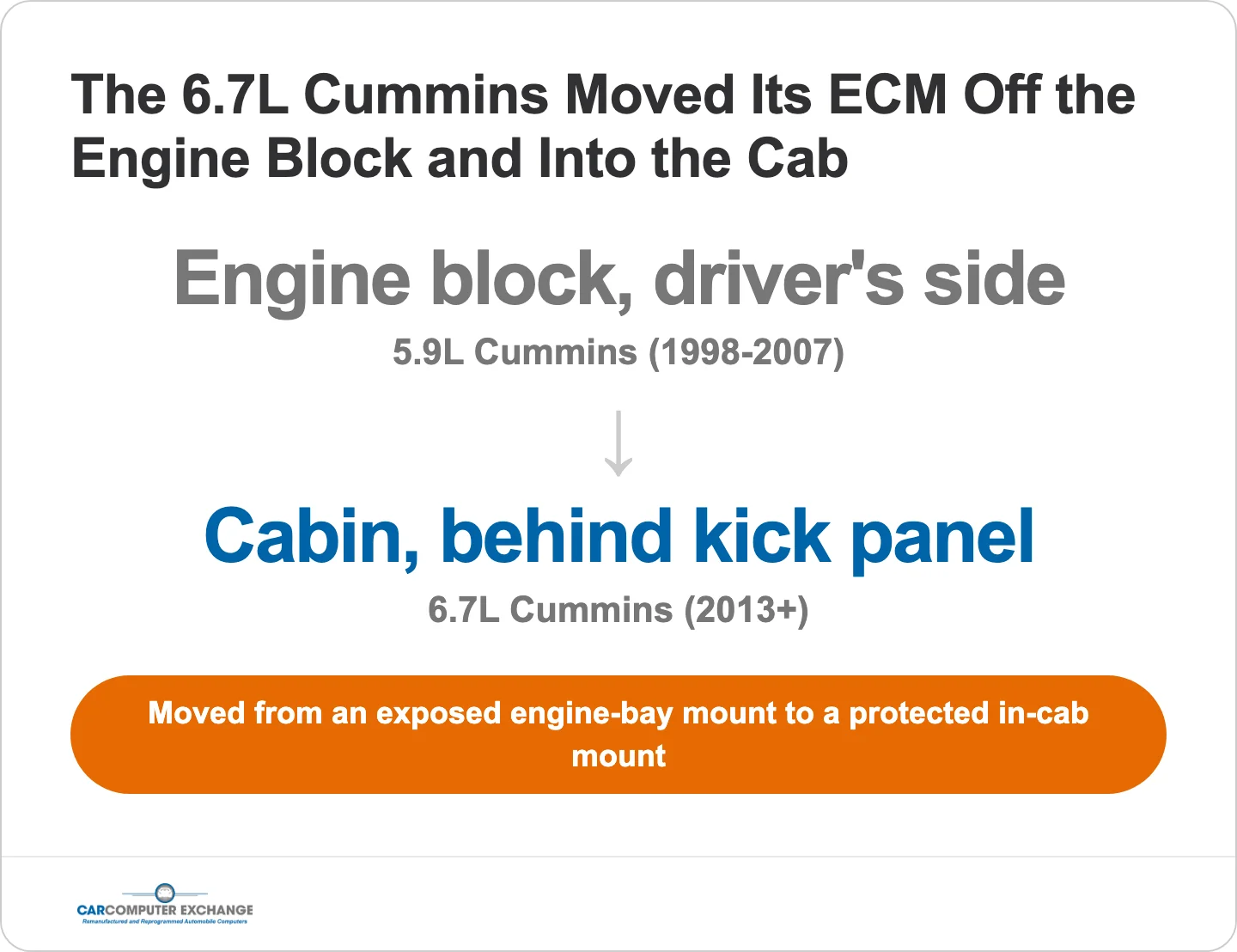
Cummins moved the ECM off the engine block and into the cabin starting with the 6.7L. Source: Cummins Forum.
How to Find the PCM on Your Vehicle
Once you know the general area, two steps confirm the exact module every time:
- Trace the main wiring harness. Follow the thick bundle of electrical wires and sensor harnesses from the engine. That bundle leads directly to the PCM, since the module is where most of the vehicle’s sensor wiring terminates.
- Look for the box. The PCM is a flat, rectangular metal case, often aluminum with cooling fins, with one or more large plastic connectors plugged into it. Depending on the vehicle, it may be labeled “Engine Control Module,” “Powertrain Control Module,” “Engine Control Unit,” or “ECU.”
If you see a sealed metal box with a few big connectors and a bundle of wires running into it, you have found the module. Do not unplug anything with the battery connected. Disconnect the negative battery cable first.
PCM vs ECM vs ECU: Does My Car Have a PCM or ECM?
Your car has a PCM if a single module controls both the engine and the automatic transmission, and an ECM if the module controls the engine only. The PCM (powertrain control module) combines engine and transmission control into one unit. The ECM (engine control module) handles fuel, ignition, and emissions for the engine alone, with a separate transmission controller.
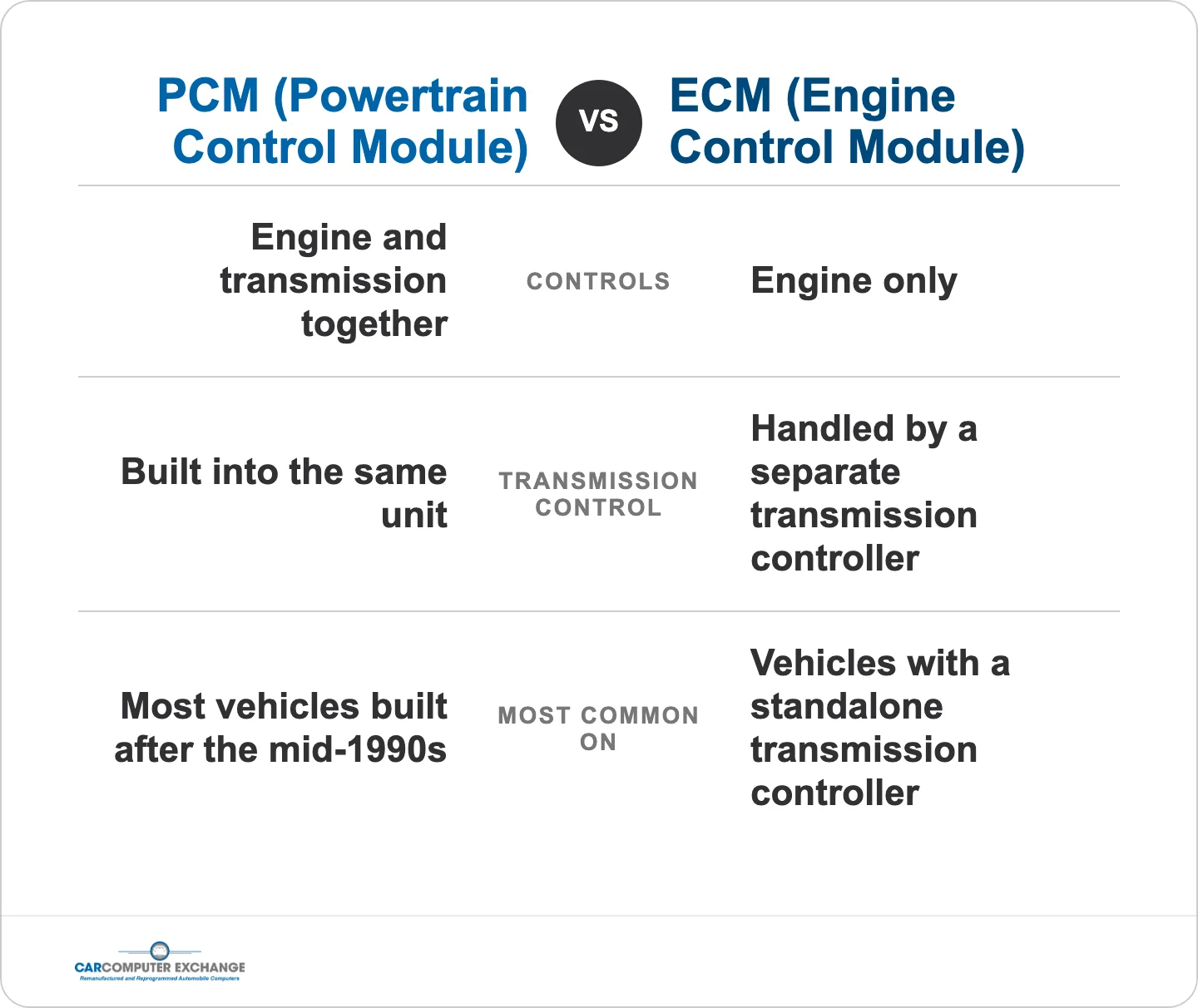
A PCM handles the engine and transmission in one unit. An ECM handles the engine alone.
ECU (engine control unit) is a generic term that can mean either one. In practice, most vehicles built after the mid-1990s use a single PCM, so the terms get used interchangeably. If you want the full breakdown, read our ECU vs ECM explainer. For finding the module, it does not matter what it is called. It sits in the same place and looks the same either way.
Where Is the PCM Fuse Located?
The PCM fuse and power relay are usually in the under-hood fuse and relay box, sometimes labeled on the box lid as “PCM,” “ECM,” or “PCM PWR.” A few vehicles place a second PCM-related fuse in the interior fuse panel under the dash. Check the fuse box diagram printed on the underside of the cover to find the exact position for your vehicle. Pulling the PCM fuse for a few minutes is also one way to reset the module.
Check the under-hood fuse box lid first. It’s often labeled PCM, ECM, or PCM PWR.
Do You Need to Reprogram a Replacement PCM?
Yes. A replacement PCM or ECM must be programmed to your vehicle’s VIN before the engine will start. Newer platforms tie the module to the anti-theft system, so an unprogrammed unit, including one pulled from a junkyard, will set immobilizer codes and prevent the vehicle from starting. This is the single most common reason a “working” used module fails to fix a car.
An unprogrammed module won’t start the car, even if it tests fine on its own.
At Car Computer Exchange, every remanufactured PCM and ECM ships pre-programmed to your VIN, mileage, and latest factory software, with keys and most anti-theft systems pre-synced. Because the module arrives programmed to your VIN, most buyers install it and drive without a dealer visit. Each module also passes a 13-point quality check on a computer-aided vehicle simulator before it leaves our facility. If you are not sure the module is the problem, confirm it with a scan tool before you replace it.
Signs Your PCM or ECM Is Failing
A failing PCM or ECM usually shows one or more clear symptoms:
- The engine cranks but will not start. The module is not sending fuel or ignition signals.
- The check engine light stays on with codes that return after you replace the sensors themselves.
- A scan tool cannot communicate with the module through the OBD-II port, which points to a dead PCM.
- The transmission shifts erratically on vehicles where the PCM controls shift timing.
For the full list and how to confirm the module is the cause, see our guide to bad ECM symptoms.
Frequently Asked Questions
How do you reset the PCM?
You reset the PCM by disconnecting the negative battery cable for a few minutes or by pulling the PCM fuse. Both methods clear the module’s short-term memory and stored trouble codes. Reconnect the battery, then let the vehicle relearn its idle and fuel settings over the first few drives. Resetting the PCM clears codes but does not fix a failed module.
How do you know your PCM is bad?
The clearest sign of a bad PCM is a no-communication result when you connect a scan tool to the OBD-II port. If the tool cannot read the module at all, the PCM has likely failed. Other signs are an engine that cranks but will not start, multiple unrelated fault codes at once, and stalling that returns after the engine warms up.
Is a PCM expensive to fix?
A dealer PCM replacement is expensive because it combines the module, programming, and labor into one bill, often $800 to $2,000 or more depending on the vehicle. A remanufactured module that ships pre-programmed to your VIN removes the separate dealer programming fee.

A dealer PCM swap bundles the part, labor, and programming into one bill.
Can I replace a PCM myself?
Yes. Replacing a PCM or ECM is a bolt-on job on most vehicles once you locate the module. It connects with one or more wiring harness plugs and a few mounting bolts, and the physical swap is a straightforward job with basic hand tools. The one requirement is that the replacement module is already programmed to your VIN, or the vehicle will not start.
The Bottom Line
Finding your PCM or ECM comes down to two questions: is it under the hood or in the cabin, and what does your make and model do. Most domestic trucks and cars keep the module in the engine bay near the firewall or battery, while many imports move it inside behind the kick panel or dash. When the table does not settle it, trace the main wiring harness and look for the flat, finned metal box with large connectors.
We have sold remanufactured, VIN-programmed vehicle computers since 2011, to more than 150,000 customers, and every module carries a free lifetime warranty when you return your old core. Once you know where your module is, find your exact PCM or ECM by entering your year, make, and model, and it arrives ready to install.
Sources