PCM Replacement in 2026: Repair, Replace, or Reprogram?
PCM replacement means installing a powertrain control module that has been matched and programmed to your specific vehicle, then finishing any relearn the car needs before it runs normally. The physical swap is usually simple. Getting the right unit and the programming correct is the part that decides whether the car starts.
We remanufacture and program replacement PCMs at Car Computer Exchange, so this guide sticks to what actually matters when you replace one, whoever you end up buying the part from. It covers when to replace a PCM instead of repairing it, what programming a replacement takes, whether you can do it yourself, and how long a PCM should last.
Key Takeaways
- Repair or replace is the first decision. A board-level repair keeps your original module, while a replacement swaps in a different unit that has to be programmed to your car.
- Programming is the hard part, not the swap. A replacement PCM has to be matched to your VIN and, on many vehicles, synced to the anti-theft system and keys before the engine will start.
- Pre-programmed units skip the VIN step. A module programmed to your VIN before it ships installs like a direct-fit part on many applications. Some still need a short key or immobilizer relearn.
- You can do the physical install yourself. If you can change your oil, you can swap a PCM. The programming and keys are what may still need a shop or a locksmith.
- A PCM usually fails from an outside cause, not age. Voltage spikes, heat, and water are the common killers, so finding why it failed keeps the replacement from dying too.
Repair or Replace a PCM: How to Decide
You repair a PCM when the housing and connectors are sound and the fault is an internal one that can be fixed, and you replace it when the unit is beyond repair or a programmed replacement is the faster, more reliable path. Both routes end the same way, with a module programmed to your exact vehicle.
A repair is a send-in service. You ship your original module, it gets tested, rebuilt, and reflashed, and it comes back set up for your car. Because it is your original unit, the VIN and immobilizer data already match, which can simplify the install. The trade-off is downtime while the module is out of the car.
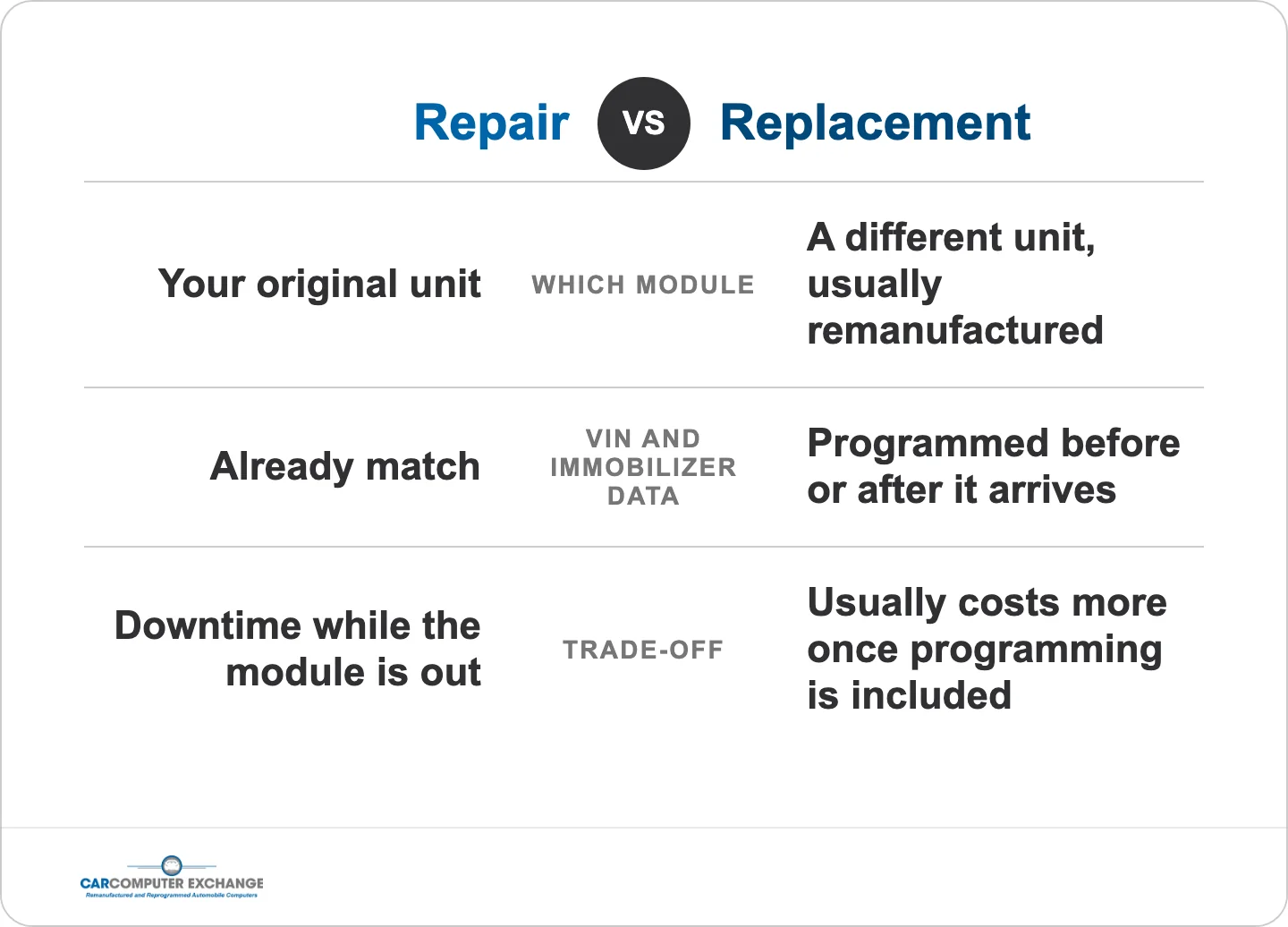
A repair keeps your original module but means downtime, while a replacement gets you back on the road faster and usually costs more once programming is included.
A replacement uses a different unit, usually a remanufactured one, that is programmed to your vehicle before or after it arrives. It gets you back on the road faster because you are not waiting on your own module, and a pre-programmed replacement is ready to install as soon as it arrives. A replacement unit usually costs more than a board-level repair once programming is included. Our breakdown of what an engine computer replacement costs covers the numbers. If your module is specifically an ECM rather than a combined PCM, our guide to replacing a car ECM covers that path.
What Programming a Replacement PCM Requires
A replacement PCM has to be programmed with your vehicle’s software and VIN before it will run the engine, and on many modern vehicles it also has to be synced to the anti-theft system and keys. A blank module does nothing in the car until this is done.
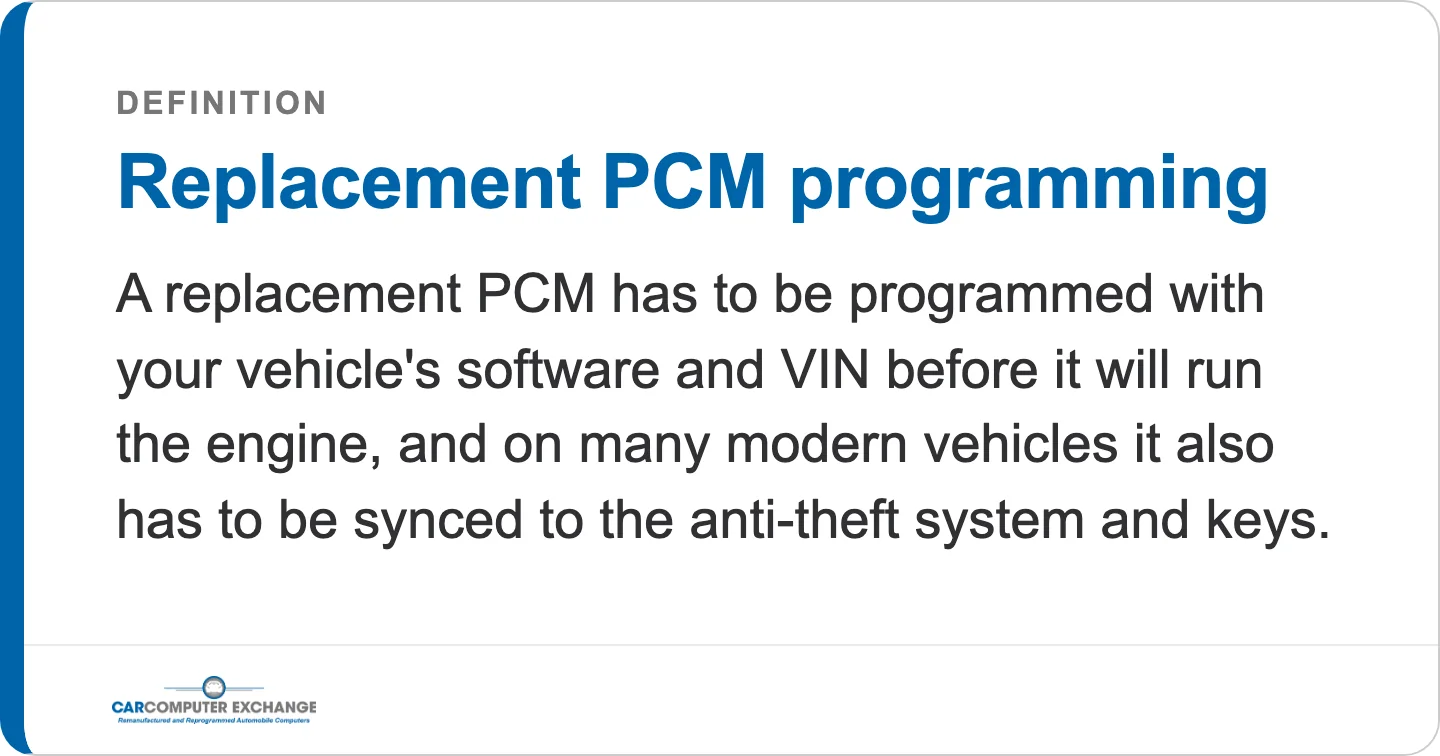
A blank module does nothing in the car until it is programmed with your software and VIN, and on many modern vehicles, synced to the anti-theft system and keys.
- Calibration and VIN. The module needs the correct software calibration for your exact year, make, model, and engine, then your VIN written to it. As the technical writer Larry Carley notes in his automotive library, a replacement memory chip “must be reprogrammed after it has been installed” if it was not already programmed for the application.
- Anti-theft sync. On newer vehicles the module has to be matched to the immobilizer so the car recognizes your keys. Carley points out that “a scan tool may be required to reprogram the PCM and to reset the anti-theft system.” Vehicles with a factory anti-theft system are the common case here.
- Relearn procedures. After the module is installed, many PCMs “have to undergo a ‘relearning’ procedure” for idle speed, fuel trim, and other operating parameters. That relearn happens over the first few drive cycles, which is why a freshly installed unit can feel slightly off or set a temporary code before it settles.
This is where a pre-programmed unit saves the most work. When a module ships already programmed to your VIN, the calibration and VIN steps are done before it reaches you, so a plug-and-play unit installs like a direct-fit part on most applications.
Blank vs Pre-Programmed vs Remanufactured PCMs
Buyers run into three terms when shopping for a replacement, and the difference decides how much work is left after the part arrives.
- Blank PCM: a module with no vehicle software on it. It is what many shops and dealers start with, and it must be programmed to your car before the engine will run.
- Pre-programmed (plug-and-play) PCM: a module programmed to your VIN before it ships. It installs like a direct-fit part on many applications, though some still need a quick key or immobilizer relearn.
- Remanufactured PCM: a tested core whose faults have been repaired and retested, then programmed for your vehicle. Remanufacturing is the common aftermarket route because a PCM has no mechanical parts that wear out, so a sound board can be restored rather than scrapped.
Can You Replace a PCM Yourself?
Yes, you can replace a PCM yourself when the unit is programmed for your vehicle before you install it. The physical swap takes basic hand tools and a few minutes. The parts that trip up a do-it-yourself install are the anti-theft sync and the key relearn, not the wiring.
The install itself is close to swapping a box. You disconnect the battery, unplug the connectors, unbolt the old module, bolt in the new one, and plug it back in. Owners who are comfortable changing their own oil handle this without trouble.
The programming is the real dividing line. If the module is not already programmed to your VIN, it needs a scan tool and the correct software, which is why many people buy a pre-programmed unit. The key and immobilizer step can usually be finished by a local locksmith as well as a dealer, so a car that needs keys paired is not automatically a dealer trip. If the car will not communicate with a scan tool at all after the swap, our guide on a scan tool showing no communication walks through what to check.
Pairing keys after a PCM swap is not automatically a dealer trip, since a local locksmith can usually finish the key and immobilizer step.
How to Replace a PCM: Step by Step
Replacing a PCM follows the same sequence on most vehicles once you have the correct, programmed unit in hand. Work through these steps in order.
- Confirm the PCM is the actual fault. A module that has been tested and confirmed bad is worth replacing. Swapping one on a guess is how people spend money and still have the original problem.
- Get the correct unit for your VIN. Match the exact year, make, model, engine, and OEM part number, and have it programmed to your VIN so it is ready to install.
- Disconnect the battery. Turn the ignition off and disconnect the negative terminal before you unplug anything. This protects the new module and clears the way for the relearn later.
- Locate and remove the old PCM. Find the module, release its connectors and mounting, and set it aside. If you are not sure where yours sits, our guide to where the PCM is located covers the common spots by vehicle.
- Install the replacement. Seat the new unit in the same mounting, reconnect the connectors until they lock, and secure it.
- Reconnect the battery and complete the relearn. Reconnect the negative terminal, start the car, and let it idle and drive through a few cycles so it can relearn idle and fuel settings. A temporary code or a slightly rough idle at first is normal during the relearn and usually clears on its own.
How Long Does a PCM Last?
A PCM is built to outlast most of the parts around it and often runs for the life of the vehicle. When one fails early, the cause is usually an outside problem rather than the module simply wearing out. Larry Carley’s automotive library notes that PCMs “typically fail for one of two reasons: voltage overloads (often due to a short in a solenoid or actuator circuit) or environmental factors (corrosion, thermal stress or vibration).”
Most PCMs fail from an outside cause, voltage overloads or environmental factors, so find why the old one failed before installing a new one. Source: Larry Carley, AA1Car automotive library.
Water is the one to watch. Once “water gets inside a PCM, it can short circuits and set up irreversible corrosion that ruins electronic connections,” which is why a flooded vehicle often needs a module and why most remanufacturers will not rebuild a submerged one.
The practical takeaway is to find why the old module failed before you install a new one. A shorted actuator or a chafed wire that took out the first PCM can take out the replacement too. The warning signs of a failing PCM overlap with a lot of other faults, and our guide to bad ECM and PCM symptoms covers how to tell them apart.
Choosing the Right Replacement PCM
The right replacement PCM matches your vehicle’s exact year, make, model, and engine, and carries the correct OEM part number. A unit that is close but not identical can fail to communicate, throw fitment codes, or refuse to start the car.
Part numbers are easy to get wrong because they often differ by a single character between two similar vehicles. Confirm the number stamped on your original module against the replacement rather than going by model year alone. A VIN-programmed remanufactured unit has a real advantage over a used or junkyard module here: it is tested, matched, and programmed for your car, while a salvage unit still carries another vehicle’s data and needs reprogramming before it will work. For more on matching the correct unit, see our guide to buying the right PCM.
Confirm the part number stamped on your original module against the replacement rather than going by model year alone.
Get a PCM Programmed for Your Vehicle
When you are ready to buy, Car Computer Exchange programs each PCM to your VIN before it ships, so it arrives ready to install on most applications. We have served more than 150,000 customers since 2011, and we remanufacture and program PCMs, ECMs, and TCMs for domestic and diesel vehicles. Every engine computer runs through a 13-point quality check on a simulator that emulates your car’s engine, transmission, emissions, and anti-theft systems before it goes out the door.
On most applications the unit is plug-and-play once it arrives, and some vehicles still need a short key or immobilizer relearn that a shop or locksmith can finish. Every replacement is backed by a free lifetime warranty with a core return, covering up to two replacement units, and a 60-day money-back guarantee if the module does not solve your vehicle’s issue. You can read the full warranty terms before you order. For platforms we handle as a send-in repair, such as high-output and Mercedes modules, you ship the original in and it comes back rebuilt and programmed.
To see the exact PCM for your car, enter your year, make, and model on our vehicle lookup, or browse modules for Ford, Dodge, and Jeep. Our team answers in English and Spanish, Monday through Friday, and you can read what buyers say in our customer reviews before you order.
Frequently Asked Questions
Can I replace a PCM myself?
You can replace a PCM yourself if it is programmed for your vehicle before you install it. The physical swap uses basic tools and takes a few minutes. The programming and any key or anti-theft relearn are the steps that may still need a scan tool, a shop, or a locksmith.
Do I need to program a new PCM?
Yes, a new or replacement PCM needs to be programmed with your vehicle’s software and VIN before it will run the engine. A pre-programmed unit has that done before it ships, so on many applications you only reconnect the battery and let the car complete its relearn.
Can I program a PCM myself?
Programming a PCM yourself requires a compatible scan tool and the correct manufacturer software, and on many newer vehicles a factory-level tool for the anti-theft sync. Most owners avoid this by buying a unit that is already programmed to their VIN, which removes the hardest part of the job.
Are a PCM and an ECM the same thing?
A PCM and an ECM are closely related but not always the same unit. An ECM (engine control module) manages the engine, while a PCM (powertrain control module) combines engine and transmission control in one module. Many vehicles use one term or the other for the same box, which is why replacement listings often show both.
Can a PCM be repaired?
A PCM can often be repaired rather than replaced when the fault is an internal, fixable one and the housing and connectors are intact. A repair is a send-in service that keeps your original module, tests and rebuilds it, and reflashes it for your vehicle before returning it.
How do I reset a PCM?
You can reset a PCM by disconnecting the battery for a short period, which clears its short-term memory and starts a fresh relearn cycle. A reset clears temporary settings, but it does not fix an internal fault, so a module that keeps failing after a reset points to a hardware problem.
Will a used or junkyard PCM work without programming?
A used or junkyard PCM will usually not work without programming, because it still carries the donor vehicle’s VIN and anti-theft data. Most have to be reprogrammed to your car, and on vehicles with an immobilizer the keys have to be paired, so a salvage unit rarely installs as a straight swap.
How long does it take to replace a PCM?
The physical PCM swap is usually the quick part of the job once you have the correct unit. Programming and any anti-theft relearn are what add the most time, and a pre-programmed unit shortens the job because the calibration and VIN work is already done.
Does the PCM control the transmission?
On many vehicles the PCM controls the transmission as well as the engine, which is the difference between a PCM and a standalone engine control module. Vehicles that keep transmission control separate use a dedicated transmission control module (TCM) instead.
The Bottom Line
PCM replacement comes down to two things: getting the correct unit for your vehicle and making sure it is programmed to your VIN. The physical install is within reach for most owners, and the programming and key relearn are the steps worth planning for before you start.
We rebuild and reprogram engine computers for domestic and diesel platforms at Car Computer Exchange, test every one on a 13-point quality check, and back it with a lifetime warranty and a 60-day money-back guarantee. A PCM matched and programmed to your VIN is what turns a no-start back into a car you can drive.
Ready to order the right one? Look up your year, make, and model on our vehicle picker to see your exact PCM.
Sources